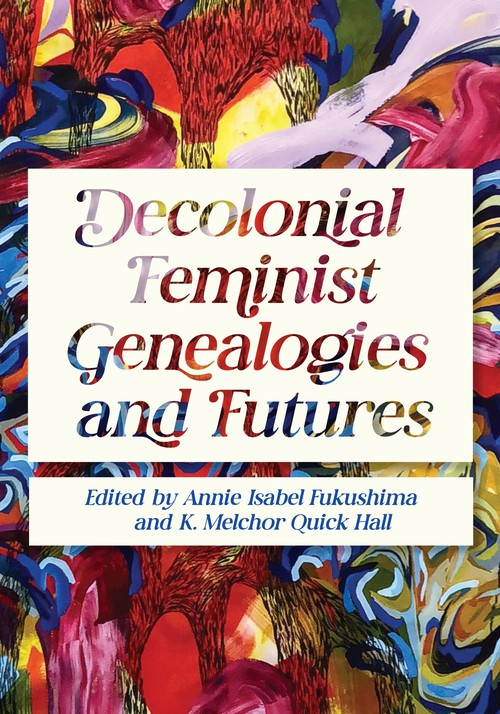
Decolonial Feminist Genealogies and Futures at the Puerto Rico Convention Center in November and Discount Code for Book

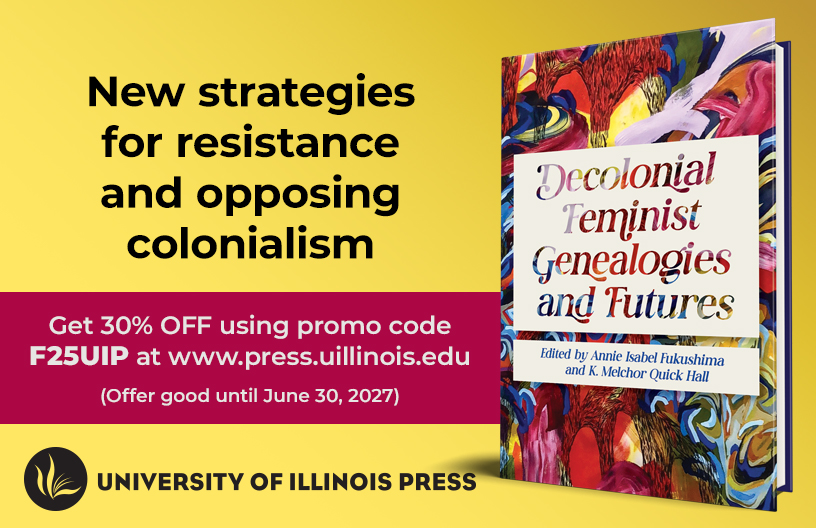
Decolonial Feminist Genealogies and Futures is ready for purchase!

Join me at the National Women’s Studies Association for the launch of Decolonial Feminist Genealogies and Futures at the Puerto Rico Convention Center November 13 for back-to-back panels 2:30PM – 5:15PM and book signing at the UIP booth at the center on Nov. 14 at 2:30PM. Details below.

If you are interested in ordering the book, please use the

discount code: F25UIP

At NWSA this November

Feminist Genealogies & Futures (part 1)
Thursday, November 13, 2:30pm – 3:45pm
Room 208 A, Puerto Rico Convention Center

Main Organizer: Annie Isabel Fukushima
Co-Organizers/Presenters: Linda Carty and Chandra Talpade Mohanty

Presenters: Lydia Zakel, Rachel Afi Quinn, Ana Carolina Antunes, and Esther O. Ajayi-Lowo

Feminist Genealogies & Futures (part 2)
Thursday, November 13, 4pm – 5:15pm
Room 208 A, Puerto Rico Convention Center

Main Organizer: K. Melchor Quick Hall
Co-Organizers/Presenters: Linda Carty and Chandra Talpade Mohanty

Presenters: Lynn Hampton, Sylvia Mendoza Aviña, Xamuel Bañales

Book signing

Friday, November 14 at 2:30pm

University of Illinois Press booth, Puerto Rico Convention Center, NWSA

Faculty Development Program on Discoursing Gender Equality, Human Rights and Social Justice in Education and Research

August 28-September 4, via Zoom.

Concept Note
Higher Education Institutions (HEIs) bear a profound responsibility and perform a crucial role not only in the dissemination of knowledge, but also in societal transformation. They are the centres of knowledge, tasked with integrating gender equality, achievement of human rights, and enhancement of social justice into their curricula. This not only constitutes desirable behaviour in the contemporary global context, but forms a part and parcel of the comprehensive mission of higher education. Such priorities also strongly re-sound in the United Nations Sustainable Development Goals (SDGs)- especially, SDG 4 (Quality Education), SDG 5 (Gender Equality), and SDG 10 (Reduced Inequalities)- all of which sum inspires the importance of inclusive, equitable, and lifelong learning opportunities to all.

However, on any policy promise, there remains disproportionate representation as described by gender, caste, class, and ethnicity, among other identity elements, which persist in the academic and research arena. These differences do not only threaten the ideas of inclusiveness and justice but also restrict the transformative power of education itself. Hence, there is an urgent need to critically involve HEIs in the process of reflecting and redeveloping institutional practices, pedagogical approaches and research agendas with the prism of equity and rights. Organized with this aim, this Faculty Development Programme aims at providing a platform to academicians, policy makers, administrators and researchers interested in investigating different forms of inequality, and its impact on individuals and society.

Objectives:
To enhance knowledge on the issues of gender equality, human rights and social justice in education
To develop curricula aimed at inclusive education through innovative teaching pedagogies
To create awareness of policy frameworks and advocating strategies
To promote gender-sensitive approaches and advocacy of human rights in educational settings
To encourage inter/multidisciplinary research opportunities for humanities and social sciences

https://lnkd.in/gEm-5Np9

Registration fees:
• Academicians
• Scholars/Students
• Industry Experts & others
• For International Participants
: 500/- : 200/- : 700/-
: $15 USD

Decolonial Feminist Genealogies and Futures

Author: Edited by Annie Isabel Fukushima and K. Melchor Quick Hall

Series: Dissident Feminisms

Early order a copy of the book

The editors organize the essays in four thematic sections: subversive labor; spatialities and temporalities; resistance; and genealogies and feminist futures. Inspired by outside catalysts like sharing circles and poetry, the contributors challenge the boundaries of time and space that we imagine as constraints on labor and resistance. Their methodological approaches include participation observation, pláticas, critical participatory action research, spatial analysis, interviews, testimonio, grounded theory, and historical analysis.

Interdisciplinary and diverse, Decolonial Feminist Genealogies and Futures draws on a unique history of thought and action to map a new generation of practices.

Contributors: Chandra Talpade Mohanty, Esther O. Ajayi-Lowo, Ana Carolina Antunes, Xamuel Bañales, Azza Basarudin, Tina Beyene, Linda Carty, Elisa Contreras, Janice Cindy Gaudet, Lynn Hampton, Amanda Jurno, Eun-Jin Keish Kim, Shireen Keyl, Leece Lee-Oliver, Monique Lemos, Xochitl E. López Andrade, Tricia McGuire-Adams, Sylvia Mendoza Aviña, Akanksha Misra, Cueponcaxochitl D. Moreno Sandoval, Bruno Moreschi, Rachel Afi Quinn, K. Melchor Quick Hall, Angel Sutjipto, Miriam G. Valdovinos, and Lydia Zakel

At the Core of Discovery: How Utah’s Research Community Builds Talent and Drives Impact

By Xoel Cardenas, Sr. Communications Specialist, Office of the Vice President for Research

Creatives. Mentors. Leaders. Innovators. Optimists.

These are just some of the words that describe the University of Utah’s research community.

Excerpt:

“Mentoring is an ever-evolving concept, practice, and relationship, where mentors are trusted people who guide a mentee’s process. Mentoring is something we learn not only by doing, but by experiencing it…. Research mentoring is not about individuals, but about a collective commitment to each other and our promise that we can collectively thrive in research environments — peer-mentors, students, staff, faculty, and community, together.” – Annie Isabel Fukushima, Associate Dean, Undergraduate Studies

Read more to learn more about different perspectives on research mentoring at University of Utah

 University of Utah Office of Undergraduate Research University of Utah

Ep. 10: From Curiosity to Breakthroughs: The Power of Undergraduate Research l TOGETHER PODCAST

Check it out. Fukushima in the Together Podcast.

In this episode of Together: A Higher-Ed Podcast, we’re joined by Dr. Annie Isabel Fukushima and Dr. Alexa Sand to explore the transformative impact of undergraduate research. Dr. Fukushima and Dr. Sand share their journeys into academia, the mentors who shaped their careers, and how they now empower students to become researchers, innovators, and leaders. They discuss the importance of fostering curiosity, embracing failure, and breaking barriers to make research accessible to all students. We also dive into the upcoming 25th Anniversary of Research on Capitol Hill, an event showcasing the best undergraduate research from Utah’s top institutions. Learn more here https://our.utah.edu/roch

“It builds resilience. From being wrong, to failing and falling on your face. And then getting up and doing it again, and again, and again until you find something. Every sort of limb that they are loping off question is actually part of the discovery of new knowledge… The mentoring, it is not a straight line. The mentoring piece of it builds this community.” – Alexa Sand.

“It’s all about the question… when we really care about our society and our communities, we want to ask questions so we can solve problems. And there are many questions we can ask. And it’s really hard to find the question you really want to ask and find the answer. And when I teach my students in methods, in ethnic studies methods, one of the things we start to navigate is we start with this framing. That research happens the moment we have a question and we seek to find an answer. We as communities are always doing research, but there’s different ways that research happens in different environments. Disciplines might create more structure and necessitate that because there is such a deep history of people who have worked to answer that question… we’re building on things that exist” – Annie Isabel Fukushima

“I think about that connection to the impact that our universities have on the citizenry. Not just our state. But the region, the nation, the world. Empowering people in someways, what I hear you both describing, tell me if I am wrong, but people who are less fearful of asking critical questions to challenges that maybe other folks have contributed to the historiography or the body of knowledge that precedes us. And in some ways being less fearful of saying ‘that person tried to answer the question and I take issue with how they have answered that question. I think the answer is actually over here.’ That gets at the heart of what great research universities do” – Chase Hagood

Chicana/x and Latina/x Feminisms – Online Course

ETHNC 5730 – 090 
ETHNC 6940 – 090

This course explores the theoretical contributions of historical and contemporary Chicana, Chicanx, and Latina/e/x feminist scholars. An interdisciplinary course, students will learn to apply these theories to works across fields of the social sciences and humanities. We will study the writings of Chela Sandoval, Sonia Saldivar-Hull, Emma Perez, Gloria Anzaldúa, María Lugones, and other leading Chicana/x and Latina/x theorists to better understand a feminism that transcends national borders and ethnic identities. Central to the course is also contending with queer Chicana/e/x and Latina/e/x formations. Some of the topics and concepts we will cover include colonization, diasporic subjectivities, (de)colonization methodologies, consciousness, and borderlands.

Research Groundbreakers: Spotlighting Ashton, Fukushima, Rothberg, Simmons and Williams for their research work at the U

The University of Utah has a rich research history. Thanks to its students, faculty, staff and shareholders, research at the U will only continue to grow, bringing innovations and discoveries to our society.

With this in mind, the Office of the Vice President for Research (VPR) and Office of Sponsored Projects (OSP) are showcasing different researchers to spotlight our university’s studies and potential breakthroughs. Here are some of the U’s Research Groundbreakers.

Dr. Annie Isabel Fukushima – Featured and interviewed for Hulu’s ‘Out There: Crimes of the Paranormal’ – Episode 8, ‘The Ghosts of Chinatown’

Dr. Annie Isabel Fukushima was featured and interviewed for the Hulu special “Out There: Crimes of the Paranormal” – Episode 8, “The Ghosts of Chinatown” produced by the Duplass Brothers and directed by Dolly Li.

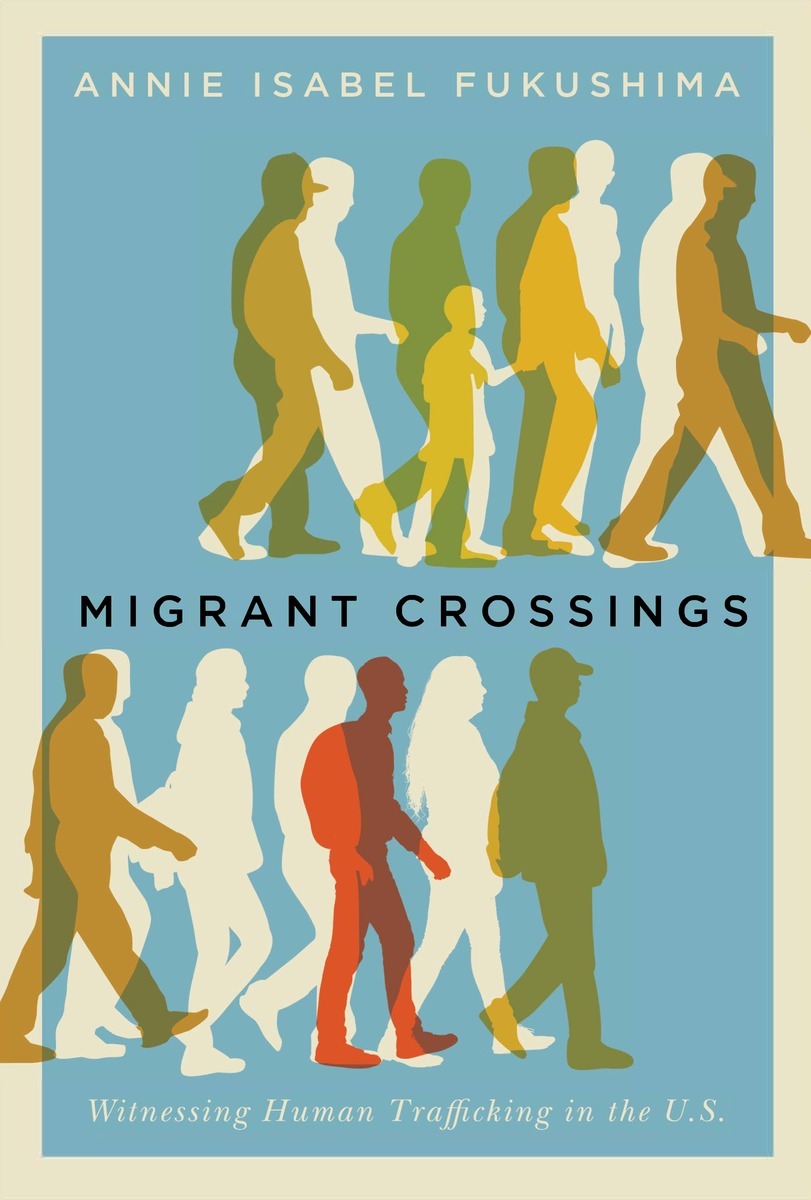
Fukushima served as an expert witness for a criminal case in 2012. Discussion of the case appeared in her award-winning book, Migrant Crossings: Witnessing Human trafficking in the U.S. (Stanford University Press, 2019), which received the American Sociological Association’s Book Award on Asia America. The Ghosts of Chinatown is based on a legal case of People of the State of California Plaintiff v. Tam, Liu, Wu, and Zeng. The complicated case involved elders being scammed and also tapped into a community’s belief system about ghosts and ghost marriages.

As part of the societal impact of her research as an ethnic studies scholar, Dr. Fukushima has offered her expertise for criminal, civil, and immigration cases. Her expertise in racialized and gender-based violence is nationally recognized. “We oftentimes think of research and the furtherance of knowledge in scholarly publications, grant implementation, and as pedagogues in the classroom,” said Fukushima. “However, the scholar’s impact is so wide and how we further knowledge can even shape policy, law, and the courtroom.”

In this particular case, it was one where immigration, criminalization, and quasi-human trafficking cohered. Over a decade later, the case was covered on Hulu because the use of ghosts to facilitate scams has re-emerged.

Check out the full-length groundbreakers here.

Speaking Engagements for Hispanic Heritage Month

As a KoreXicana I am very proud to participate in conversations that support Latinidad Heritage month.

Film & Panel Lead Community Conversation: 915 Hunting Hispanics

September 24, 2024
6PM – 8PM
Salt Lake City Main Library
Nancy Tessman Auditorium

Shaping the Future Through Wellness

Center for Community & Cultural Engagement
Crimson Conversation event will be Tuesday, September 17th, from 11-1PM in Union 293 (Union Treehouse).

Seeing Race & Sexuality: Child Welfare & Forced Labor

To access visit: https://scholarworks.uark.edu/cgi/viewcontent.cgi?article=1252&context=alr

Fukushima, A.I., Nilson, J., & Richards, K. (2024). Seeing Race & Sexuality: Child Welfare & Forced Labor.” Arkansas Law Review 77, 2: 283 – 312.

“Seeing Race & Sexuality: Child Welfare & Forced Labor” co-authored by Dr. Annie Isabel Fukushima, Jens Nilson, and Kaden Richards examines how child welfare responds to children who are forced to labor through a case study of California. Using an intersectional framework, the authors argue that a conceptualization of current sociolegal responses to human trafficking cannot be delinked from racialized and sexualized forms of governmentality. In contrast to the plethora of research on trafficking into sexual economies, child labor trafficking into commercial industries beyond sex industries is viewed as hidden or understudied. Few studies examine child welfare responses to child labor trafficking by examining the centrality of race and sexuality in sociolegal responses; therefore, this article offers a unique intellectual and policy theoretical intervention. To do so, this study employed mixed-methods analysis of case study analysis of child welfare responses to child labor trafficking in California. Data for this study was gathered between 2019 and 2021, including surveys (n=1,570) and structured interviews (n=11).

To view the entire journal issue visit: https://scholarworks.uark.edu/alr/vol77/iss2/

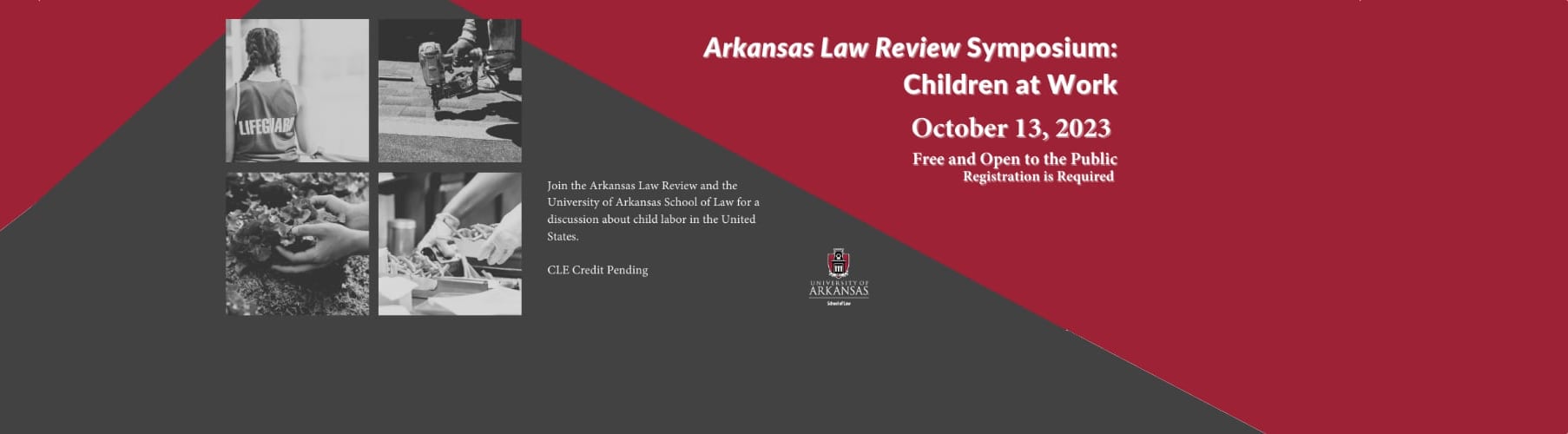
Issue emerged from the Arkansas Law Review Symposium: Children at Work (2023)

https://law.uark.edu/symposium2023

Research as a Public Good – Recognizing Research

Dr. Annie Fukushima, Associate Dean of Undergraduate Studies and Director of the Office of Undergraduate Research, who gave the opening remarks at the awards ceremony.  “Undergraduate research is a public good. What our students do to foster research in their collaborations – whether it’s a research team of one or many – is that they are furthering knowledge and supporting the university’s mission as well as having impact on society, changing people’s lives.”

Undergraduate research at the University of Utah shined bright and was celebrated, as the future leaders and innovators of tomorrow and their mentors were honored at the Office of Undergraduate Research Awards, held on April 1 in the Union Building Ballroom.

Each year, the Office of Undergraduate Research (OUR) recognizes U students and mentors with several awards, including the Outstanding Undergraduate Researcher Award, the Outstanding Undergraduate Research Mentor Award, and presents certificates to scholarship recipients.

https://www.research.utah.edu/events/outstanding-u-of-u-undergraduate-researchers-and-mentors-honored-at-the-our-awards

Undergraduate Research – Early Connections at the First Year Experience Conference

Join me at the First Year Experience Conference. At 11:30AM, March 8, 2024, in SFEBB 1170 at the University of Utah.

I will be facilitating a session on “Undergraduate Research – Early Connections”

Session description: Imagine you are new to the university and higher education environments? How do you create community? Connect with mentors? Oftentimes research is seen as something only for the sciences. But research occurs the moment you have a question and you are seeking an answer. Learn about the possibilities of facilitating student retention and connection to institutions through early access to undergraduate research. Participants will learn about a novel program launched at the University of Utah to support students in the first 60 credits with accessing research opportunities. #undergraduateresearch University of Utah Office of Undergraduate Research

https://utahfye.org/conference-schedule

INTERDISCIPLINARY POST-DOCTORAL AND FACULTY TRAINING FELLOWSHIP


Fellowship Start Date: August 1st 2024, Fellowship End Date: July 31st 2026

Apply Now

STEM education research on inclusive environments and interdisciplinary STEM research is growing. As the field continues to reflect dynamic communities and community research priorities, this novel post-doctoral program seeks to bring to the center critical frameworks. Through a thematic of “Queering STEM Education” we propose to bring together a cohort of STEM education and science studies scholars who take seriously critical frameworks of queer, decolonial, transnational, and / or intersectionality. To queer is to offer a critique, to contest the “naturalization of the categories of normal and deviant sexuality and binarized notions of sexed anatomy, gender identity, sexual desire, and sexual identity” (Thinking with Kristina Gupta and David Rubin 2021). To bring to the center analytics that are historically on the margins of STEM research, is, so to speak, a queering endeavor. Therefore, to queer STEM is truly an interdisciplinary and methodological complex undertaking. That is, to queer is to contend with the norms with how one does research, the modalities of research, the subjects in research, and the research questions asked that further how we come to know what counts as STEM. As conveyed by Jin a queer methodology “only works if we know where we stand, where we are trying to go, and whom we are trying to take with us” (Haritworn 2017). As fields of STEM seek to diversify, it is ever more pressing through a cohort model of scholars that we also to take seriously how research is done, and how a next generation of scholars are supported and trained to cross disciplines.

Who Should Apply: This program will support the training of three postdoctoral fellows. Ideal candidates include individuals who graduated in the past 4 years, and whose research includes:

  • Discipline-based education researchers (DBER) interested in queering their methodologies or bringing into their research queer analytics.
  • Science studies scholars who bring into their research queer methods or frameworks.
  • Interdisciplinary scholars who bring to the center of their research STEM related fields.

Death world economy: Race, Meat – processing plants, and COVID-19. Environment and Planning C: Politics and Space

Hot off the press.

As COVID-19 outbreaks and deaths ravaged US meat-processing facilities, companies and officials supported production instead of people. Analyzing the content of newspaper articles, court records, press releases, and company websites, we argue that (1) despite their “essential” status, meat factory workers are a disposable labor force; and (2) factory worker dispensability is the result of a racialized historical process. The expendability of primarily immigrant and people of color laborers takes place in what we call a “death world economy”—a system through which corporations, together with the state, normalize the relegation of bodies to disease, injury, and death across time and space. Responding to the intensification of this violence during COVID-19, plant employees and their families advocate for their communities’ safety needs, highlight industry inaction, and demand accountability from companies and state officials.

Fukushima, A.I., Gaytán, M. S., & Alvarez Gutiérrez, L. (2023). Death world economy: Race, Meat – processing plants, and COVID-19. Environment and Planning C: Politics and Space, 0(0). https://doi.org/10.1177/23996544231208196.

2023 – Chicana/x and Latina/x Feminisms: Podcasts

Welcome to Chicana/x and Latina/x Feminisms at the University of Utah and student podcasts from the course.

Links to Individual Podcasts

Education

A Latina’s Educational Experience in a Predominantly White State by Kimberly

Donde Estamos (Representation of brown youth in K-12 education) by Monica and Laura

Identity and Education from a Latinx Student Perspective with Camila Castaneda and Ray Kenney

Latinx in STEM spaces: Realities, Stories, Experiences by Natalia

Oruguita Platicas by Denise

Migration

Transnational Families by Gabi

Border Crossings: A Latina Look at Cultural Agility and Sixth Sense Bridge Making + Natalie Alhonte by Women of Ambition (Alyssa)

Immigration Podcast by Melanie

Music & Literature

Breaking Norms in Mexican Regional Music by Navigating Banda and Corrido Music Genres (Xochitl)

We Will Rock You – An Analysis of Music History and Social Change by Kaden

Writing The Self in Chicana Literature by Lark

Mental Health

Papi Salvador (machismo, Chicano and Chicano mental health) by Emiliano

Mental health in the Chicana community by Lucia Flores

Machismo & Culture

Chicana Feminist Podcast (Chicana feminism and loving the men who perpetuate norms and hierarchies) by Sadie

Chicanx Feminist Final Project (gender-based violence in Latinx communities) by Omar

Sexuality & Queer Latinidad

ETHNC Final Project (Liminal Chicanx/Latinx experiences on queerness) with Xitlally and Anahy

Listen to the podcasts on Sound Cloud as a Playlist

Not all podcasts utilized soundcloud; you will find all links above.


<div style="font-size: 10px; color: #cccccc;line-break: anywhere;word-break: normal;overflow: hidden;white-space: nowrap;text-overflow: ellipsis; font-family: Interstate,Lucida Grande,Lucida Sans Unicode,Lucida Sans,Garuda,Verdana,Tahoma,sans-serif;font-weight: 100;"><a href="https://soundcloud.com/annie-fukushima" title="Annie Fukushima" target="_blank" style="color: #cccccc; text-decoration: none;">Annie Fukushima</a> · <a href="https://soundcloud.com/annie-fukushima/sets/2023-chicana-x-and-latina-x" title="2023 Chicana/x and Latina/x Feminisms" target="_blank" style="color: #cccccc; text-decoration: none;">2023 Chicana/x and Latina/x Feminisms</a></div>

Utah Conference on Undergraduate Research

February 17, 2023 – 8AM – 5PM

Approximately 640 undergraduate researchers across the state of Utah presenting at University of Utah Office of Undergraduate Research University of Utah

https://our.utah.edu/ucur

The program is now live. You can see the dynamic research occurring across the state of Utah. The event is open to the public. I hope folks will attend, send their students/ folks.

Researchers at all stages of research welcome to attend and meet other researchers. Network. And foster a thriving research community in Utah.

See what the State of Utah has to offer in research across the fields of transformative, interdisciplinary, science, engineering, medicine and health, social science, humanities, architecture, art, social work and nursing.

https://our.utah.edu/ucur

University of Utah

Weber State University

Salt Lake Community College

Snow College

Utah State University

Southern Utah University

Utah Tech University

Utah Valley University

Westminster College

#research

A Collaborative Autoethnographic Platica: The Multi-Layered Citizen in Academia

Check out this coauthored working paper, “A Collaborative Autoethnographic Platica: The Multi-Layered Citizen in Academia” by Ziwei Qi, yours truly (Annie Isabel Fukushima), and Leticia Alvarez Gutiérrez (cc’d).

Abstract: This collaborative autoethnographic platica centralizes a research methodology in which the researchers retrospectively and selectively analyze their personal experiences among three academics (authors), a Chinese, a KoreXicana, and a Purépecha/Chicana through conversations – pláticas. This paper draws upon Nira Yuval-Davis’ notion of the multi-layered citizen, whereby women of color academics belong to multiple political communities. The authors reflect on the vicissitudes of the global pandemic, yellow peril discourse, anti-immigration, ongoing racism, and gender-based violence. These sociopolitical issues are the context for what it means to teach and do research in a predominantly white institution (PWI) where exclusions are rife. The authors also discuss challenges experienced, institutional structures, and interlocking oppressions related to research and teaching.

https://www.purdue.edu/butler/working-paper-series/2022/fall.php

Ziwei Qi, Annie Isabel Fukushima, and Leticia Alvarez Gutiérrez. 2023. A Collaborative Autoethnographic Platica: The Multi-Layered Citizen in Academia. Susan Bulkeley Butler Center for Leadership Excellence and ADVANCE Purdue Center for Faculty Success Working Paper Series 5(2): pg 16-25.

Fukushima on the Daily Dish

https://www.abc4.com/dailydish/restoring-freedom-summit/  

SALT LAKE CITY, Utah (The Daily Dish) – Human trafficking impacts people around the world as well as here in Utah. An estimated 24.9 million people are being trafficked every day. The United States Senate has recognized the severity of this issue and has designated January 11th as National Human Trafficking Awareness Day.

On January 11th, the University of Utah will be hosting a Restoring Freedom Summit to raise local awareness about human trafficking and its impact on communities in Utah. According to a state-wide needs assessment conducted by the Gender-Based Violence Consortium in 2022, the top five needs for survivors of human trafficking in Utah are housing, financial support, emotional support, mental health, and family support. To address this need, the University of Utah’s Gender-Based Violence Consortium has partnered with the Healing Center for Complex Trauma and Holding Out Help to support local responses to violence, including ritualistic abuse.Holding Out HELP: Providing resources for people escaping polygamy

The Restoring Freedom Summit will provide an opportunity for professionals and community members to learn more about ritualistic abuse and Dissociative Identity Disorder, and to better understand how to respond to the complex needs of survivors. The summit will also address the lack of comprehensive services for survivors, including mental health, medical, legal services, and the lack of understanding about ritualistic abuse and its resulting symptoms. By addressing these issues, the community can work towards creating a more supportive environment for survivors.

Restoring Freedom Summit

Date: January 11, 2023

Time: 8:30am to 5:00pm

Utah Statewide Needs Assessment: Domestic Violence, Sexual Violence and Human Trafficking – 2022 Report

Download the 2022 Report

UNA Final Report 2022 High Resolution

UNA Final Report 2022 Low Resolution

“There is a need to respond to violence in the state of Utah. The overall perception of domestic violence, sexual violence and human trafficking in Utah are that conditions have worsened, the physical violence has become even more deadly. While participants of this study described a growth in local response, they illuminated how silence and the culture of Utah continues to create challenges for survivors… Across the state of Utah, domestic violence organizations conduct a Lethality Assessment Program (LAP). Between 2016 and June 2021, 24,202 LAP screenings were conducted. It was found during the last two years of LAP screenings that 3,653 cases faced high danger (Utah Domestic Violence Coalition 2022). Similar data shows that rape is the only violent crime in Utah with a rate higher than the national average. Research conducted by Dr. Melton illuminates that 40% of CODIS (Combined DNA Index System) hits are serial offenders… Human trafficking is under-reported and more difficult to identify. In 2020, there were also 182 victims of human trafficking identified in the state from the National Human Trafficking Hotline (n.d.) and 1,413 cases 2017 to 2020. Although victims of domestic violence, sexual violence, and human trafficking experience these forms of abuse specifically, they oftentimes may intersect in the form of polyvictimization where a survivor may experience multiple forms of abuse in their lifetime. This report reflects the tip of the iceberg.”

Fukushima, A.I. (2022). Utah Statewide Needs Assessment: Domestic Violence, Sexual Violence and Human Trafficking – 2022 Report. Salt Lake City, UT: Gender-Based Violence Consortium, University of Utah. https://gbvc.utah.edu/utah-state-wide-needs-assessment-2022/ 

Click through to read more about how marginalized communities experience violence, community needs, and the recommendations to address violence.

#domesticviolenceawareness #sexualviolence #humantrafficking #genderbasedviolence #racialequity #communitybasedresearch

Gratitude to: Utah Domestic Violence Coalition, Restoring Ancestral Winds, Utah Coalition Against Sexual Assault (UCASA), DCFS, the survivors and experts who contributed to this study. As well as my students who supported the research – Mikaila Barker, Tony Chen, Mariah Montoya, and Sohyun Park University of Utah Gender-Based Violence Consortium.

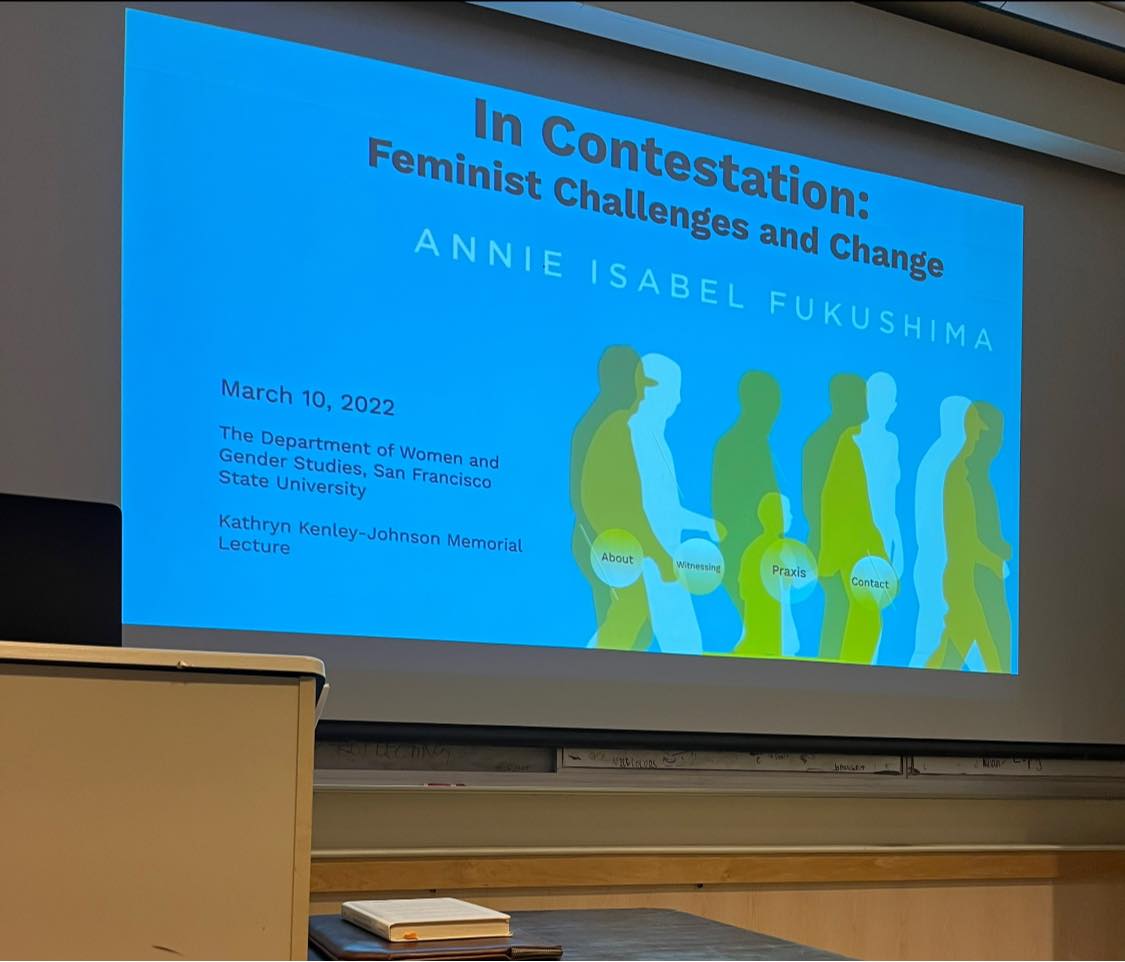
In-Contestation: Feminist Challenges and Change

Yesterday, I spoke as the keynote for the Kathryn Kenley-Johnson Memorial lecture at San Francisco State University. The title of the talk: In Contestation: Feminist Challenges and Change. It has been 10 years since I last walked on the SFSU campus. Then I was an adjunct lecturer teaching to back-to-back classes of 100 students each. I felt nostalgia and also was honored to be in conversation with students who ask provocative questions, are thinking critically, and are ready to change the world and community around them. I so appreciate the Department of Women & Gender Studies.

Book Review of Migrant Crossings in American Journal of Sociology

My book Migrant Crossings Stanford University Press was reviewed by Elena Shih in American Journal of Sociology! Thoughtful criticism and engagement with my work. All points well taken. A highlight here:

“Human trafficking is a paradox ripe for social science inquiry. Advocates emphatically assert that it is one of the most ubiquitous policy concerns of the contemporary era, yet empirically, we are told the mechanisms that drive trafficking allow it to thrive invisibly, or “beneath the surface” (“The Campaign to Rescue and Restore Victims of Human Trafficking,” U.S. Department of Health and Human Services [2003]). Annie Isabel Fukushima’s Migrant Crossings tackles this paradox head-on, by uniquely centering the act of “witnessing.” Weaving in frameworks bridging media studies, transnational feminist theory, and ethnic studies, the work brings a broadly interdisciplinary and analytically contemplative inquiry into critical antitrafficking studies. Pairing creatively wide-ranging empirical data extending from first and secondary court data to films and various media, Fukushima creates a pastiche that offers viewers a sense of how antitrafficking has created victims and saviors along racist and imperialist logics…While numerous legal and migration scholars have offered insights into the ability of antitrafficking discourse to construct the bounds of criminality and innocence, Fukushima’s exemplary weaving illustrates these boundaries around the important axes of racialization, racism, militarization, and empire….”

American Journal of Sociology

Volume 127, Number 3November 2021

BOOK REVIEW

Migrant Crossings: Witnessing Human Trafficking in the U.S. By Annie Isabel Fukushima. Palo Alto, Calif.: Stanford University Press, 2019. Pp. viii+261. $90.00 (cloth); $28.00 (paper).


Article DOI

https://doi.org/10.1086/716574

https://www.journals.uchicago.edu/doi/abs/10.1086/716574?fbclid=IwAR2pTVvji-yRAmhxO94cqhmFNv4mqHQweYn8NjEZrnMvotrDFkzqH71l5BI

Decolonial feminist pedagogies: entering into the “world” of the zombie as praxis

Check out my article Decolonial feminist pedagogies: entering into the “world” of the zombie as praxis with Tanjerine Vei published in International Journal of Qualitative Studies in Education.

To teach about race is to recognize how there are communities whose worlds are shaped by violence, death, and resurrection, such as Trayvon Martin, Michael Brown, Emmett Till, George Floyd, and the many unnamed. Resurrection invokes the zombie figure. Zombies are iconic, and as implemented in an interdisciplinary course, a means to foster opportunities to engage with a social figure whose multiple meanings are cultural, historical, and political, and also notions of race and racial meaning-making. Through the figure of the zombie, this autoethnographic revisiting of a course takes up what Lugones calls playful “‘world’-travelling.” To unpack “‘world’-travelling” we examine how it was facilitated through the “world café,” a teaching modality. This article examine an educational environment where students engaged in the complexities of race relations in the US by hacking learning rituals that foster understanding racism

Annie Isabel Fukushima & Tanjerine Vei Decolonial feminist pedagogies: entering into the “world” of the zombie as praxishttps://doi.org/10.1080/09518398.2022.2025489

Collaborating with Undergraduate Researchers at the U

https://our.utah.edu

Dear Colleagues,

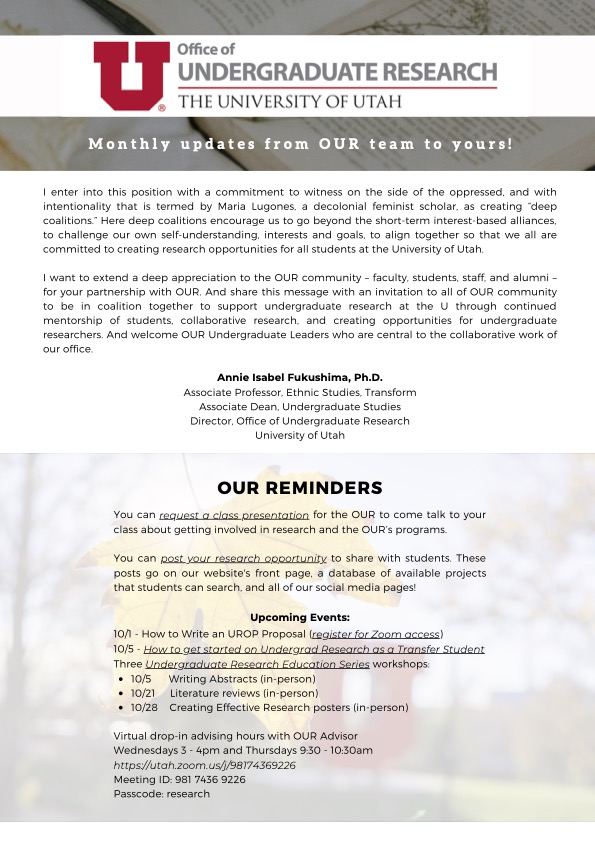
The Office of Undergraduate Research and the Office of the Vice President for Research are committed to fostering and supporting faculty success in research through collaborations with undergraduate researchers.

The Office of the Vice President for Research (VPR) provides resources and support for University of Utah’s researchers to foster an environment of creativity, discovery, and advanced knowledge.

The Office of Undergraduate Research (OUR) resides in the Office of Undergraduate Studies. The mission of the University of Utah Office of Undergraduate Research is to facilitate and promote undergraduate student-faculty collaborative research and creative works in all disciplines throughout the University of Utah campus. In recognition that excellence requires diversity, OUR pursues this mission through equitable programming that promotes diverse representation and social justice. OUR is well recognized for programming including Undergraduate Research Opportunities Program (UROP), the Summer Program for Undergraduate Research (SPUR), the Undergraduate Research Scholar Designation (URSD), Undergraduate Research Symposia (URS Spring, Summer, and Fall), the annual Undergraduate Research Journal, and the Undergraduate Research Education Series, among other exciting opportunities.

The VPR Office and OUR have a longstanding history of collaboration to fulfill the university’s mission to foster student success by preparing students from diverse backgrounds for lives of impact as leaders and citizens through research.

To better serve researchers, faculty and student alike, and effectively collaborate with staff, we offer the following recommendations:

  • Undergraduate researchers can be vital collaborators, contributors on a research team, and are the next generation of future researchers. We encourage researchers with grants or foundation funds budget to incorporate compensating undergraduate researchers as part of their team. Undergraduate researchers can play a significant role in assisting a research project and supporting and undergraduate researcher fosters the mentoring environment the University of Utah is committed to. For National Science Foundation grantees, it is encouraged the Principal Investigator(s) consider making their project a Research Experiences for Undergraduates (REU) Site. Consult with your college Associate Dean of Research, Dean, or Office of Sponsored Projects.
  • Undergraduate researchers can be onboarded in a myriad of ways, here are two options for paid undergraduate researchers:
    • Hire undergraduate researchers as part-time temporary employees through Human Resources. Students are able to then be paid through payroll where they receive direct payments via direct deposit or a check sent to their address. Additionally, if hiring a non-University of Utah researcher, this allows HR to offer a UNID to the undergraduate researcher which provides access to UTA, the library, student life center, and RedMed. Consult your college human resources analyst if you have questions, or contact Human Resources to learn more about department/college contacts.
    • Some NSF grantees are considered an NSF Research Traineeship Program. If this applies to you, then we encourage you to onboard your undergraduate researcher as a trainee. If this is the case, please consult with Financial and Business Services. If onboarding a non-University of Utah researcher, consult FBS in advance of onboarding the student to find out if your researcher will have taxes deducted or be eligible for an affiliate UNID.
    • Encourage your researcher to take advantage of programming and resources with OUR. OUR offers the following:
      • Coordinates and brings together partners across campus working with undergraduate researchers through the Summer Programs Partnership.
      • Provides other financial opportunities including Travel & Small Grants of up to $500; Undergraduate Research Opportunity Scholars Program (UROP); and we provide scholarships.
      • Student researchers may be eligible for an Undergraduate Research Scholar Designation that shows up on their transcripts and includes a cord at graduation.
      • Have your undergraduate researcher share the amazing research that also fosters professional development by presenting at the Undergraduate Research Symposium.
      • Educational programming is vital for ongoing learning for undergraduate researchers across campus, check out the OUR Undergraduate Research Education Series.
      • Information sharing is vital to research – OUR has a wide-network of social, email communities, and opportunities that we are more than happy to promote opportunities to OUR community.
      • OUR provides advising to any undergraduate researcher at the University of Utah. We see our role as supporting researchers at any stage of their research journey and are here to support faculty working with undergraduate mentees.

The OUR and VPR Office are here to support all faculty and student research collaborations at the University of Utah. We are committed to research innovation and collaboration, and invite folks to consult with our offices.

Annie Isabel Fukushima, Associate Dean of Undergraduate Studies & Director, Office of Undergraduate Research

Jim Agutter, Senior Associate Dean, Undergraduate Studies

Erin Rothwell, Interim Vice President for Research

XIII Annual Ob/Gyn Department Domestic Violence Forum 2021

Ob/Gyn GRAND ROUNDS
Department of Obstetrics & Gynecology
Santa Clara Valley Medical Center

Thursday, October 14, 2021 – 8-10am

Speakers:             

Ruthven Darlene, MA – Founder and Executive Director, Women of Silicon Valley
Annie Isabel Fukushima, PhD Associate Professor, Ethnic Studies and Associate Dean, Undergraduate Studies, University of Utah       
Maya Rossin-Slater, PhD – Assistant Professor Stanford Health Policy, Stanford University School of Medicine

Objectives:     Upon completion of this learning activity, the learner should be able to:

  • Get acquainted with on-going policy and research in maternal and child well-being and how public policies can have an effect on disadvantage populations.
  • Become Familiar with current status of different populations trafficked in the US.
  • Recognize that domestic violence may affect affluent families, and get informed about options available.

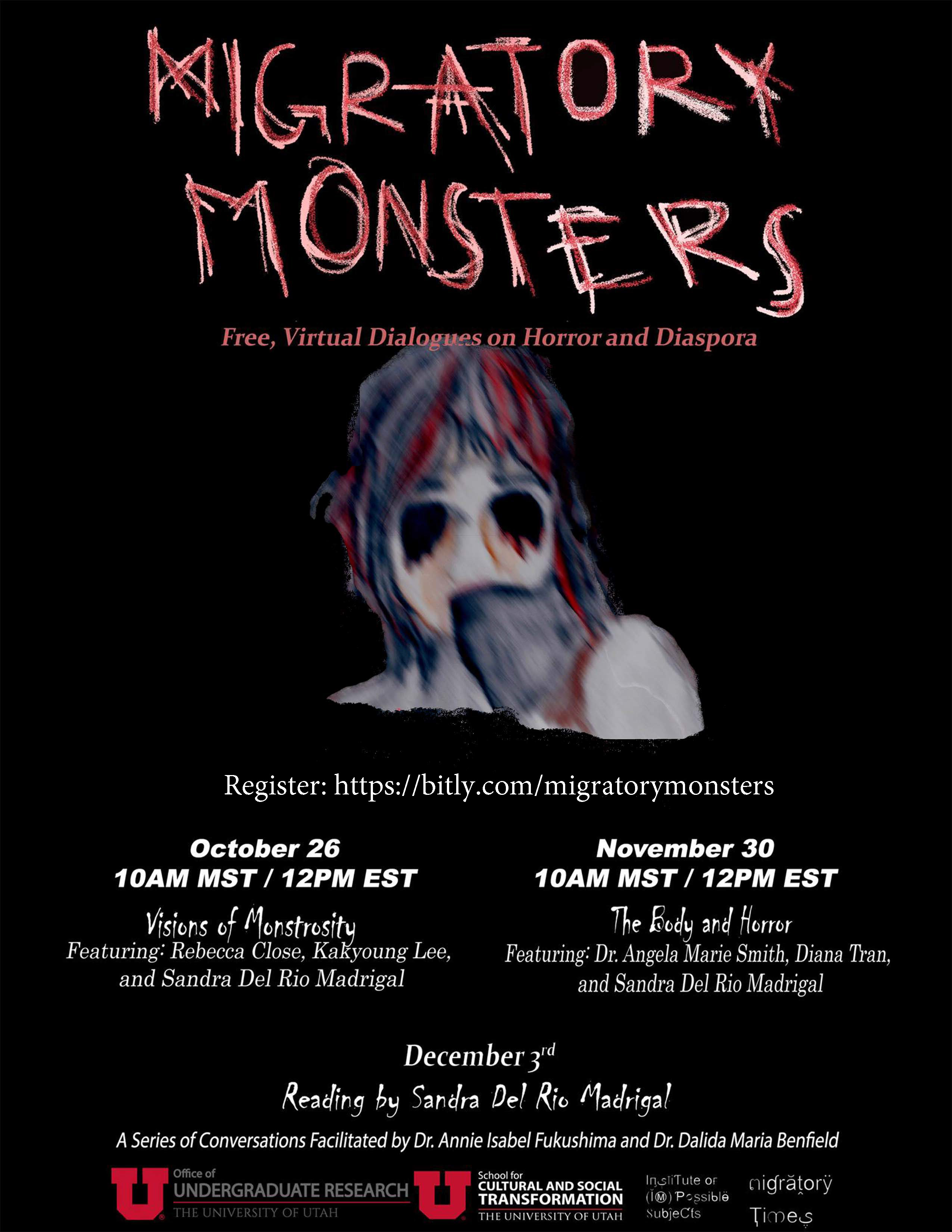
Migratory Monsters Series

October 26 10AM MST / 12PM EST – Visions of Monstrosity
Rebecca Close, Kakyoung Lee, Sandra Del Rio Madrigal

November 30 10AM MST / 12PM EST – The Body and Horror
Dr. Angela Smith, Diana Tran, Sandra Del Rio Madrigal

December 3 – Time TBD – Author Reading
Sandra Del Rio Madrigal

Register: https://bitly.com/migratorymonsters
Facilitators: Dalida María Benfield and Annie Isabel Fukushima With The Institute of ImPossible Subjects

Forum on the Future of Comparative, Postcolonial, and Decolonial Work

Invitation to Participate

Forum on the Future of Comparative, Postcolonial, and Decolonial Work

University of Utah

Salt Lake City, UT

October 1-2 

Virtual & Free

To register:

https://docs.google.com/forms/d/e/1FAIpQLScTnP2L2CH7H6GWetRiLSU4NqW3YRdc9B_vRZUGRRLJNz6ASg/viewform

You are warmly invited to participate in a two-day free event, “Forum on the Future of Comparative, Postcolonial, and Decolonial Work,” held virtually on October 1-2.

Supported by both the College of Humanities and the Department of Writing and Rhetoric Studies at the University of Utah, the “Forum on the Future of Comparative, Postcolonial, and Decolonial Work” is a research and pedagogical initiative aimed to bring together three respective disciplinary fields of work to offer a critical and sustainable space for engaging in conversations and debates on future directions for the intersectionality of comparative, postcolonial, and decolonial work. The forum takes the position that we all are implicated in a scatter of hegemonic structures of thought and feeling and world system designs. While as scholars and educators we cannot escape the predicament of producing knowledge and legitimizing disciplines, it is possible to carry out our work, otherwise, to imagine new horizons that are more attuned with the decolonial principle of pluriversality. The forum aims to be an example and advancement of such work. Comparative, postcolonial, and decolonial scholars and graduate/undergraduate students, stakeholders, and community members are invited to discuss the origins, debate the impact, and deliberate the future of comparative, postcolonial, and decolonial work over the course of two days.

Schedule

DAY 1

Comparative Work

Co-Leaders: Bo Wang & Jerry Won Lee

Postcolonial Work

Co-Leaders: Annie Fukushima & José Cortez 

DAY 2

Decolonial  

Co-Leaders: Lisa Flores & René Agustín De los Santos

Panel Discussion  

Co-Leaders: Bo Wang, Jerry Won Lee, Jose Cortez, Annie Fukushima, René Agustín De los Santos, and Lisa Flores.

Editorial: Anti-Trafficking Education: Sites of care, knowledge, and power

Annie Isabel Fukushima, Annie Hill, and Jennifer Suchland

Read full length editorial here: https://www.antitraffickingreview.org/index.php/atrjournal/article/view/573/424

Excerpt:

Soon after the World Health Organization (WHO) discovered a mysterious coronavirus in Wuhan, China, in January 2020, the world faced a global pandemic. By July 2021, it was estimated that more than 196 million people were infected and more than 4 million had died, with untold global effects.[2] The pandemic led to governmental responses such as lockdowns, curfews, and other restrictions on movement that affected schools, services, businesses, families, and communities. Countries around the world wrestled with questions like: How to teach children learning from home?[3] Who counts as an essential worker?[4] How to deliver services when social systems are strained or in danger of collapse?[5] In this context, the anti-trafficking movement, composed of educators, activists, service providers, healthcare workers, and many others, faced demands for distanced connections utilising online learning, telehealth services, Massive Open Online Courses, virtual exchange, and other forms of digitally-mediated communication.[6]

During the pandemic, people began to understand ‘Zoom’ connections as part of an everyday lexicon where web-video meetings were a central form of communication. While some people saw the possibilities to radically alter and expand education, the pandemic also exacerbated neoliberal market pressures that privilege privatised teaching and learning, entrench the digital divide, and threaten local and Indigenous knowledge systems.[7] Additionally, it was apparent that vulnerable populations were rendered even more vulnerable due to economic instability, resource scarcity, and heightened conditions of exploitation, to name but a few of the pandemic’s effects.[8] And yet, at the same time, global uprisings for Black lives in the summer of 2020,[9] and protests against anti-Asian rhetoric and racism,[10] enabled many people to see that education is critical for challenging white supremacy and colonialism, including within the anti-trafficking movement.[11] In effect, education became highly visible due to the pandemic because everyone needed to know about the coronavirus and learn new ways to interact, communicate, work, and organise online, in-person, locally, and globally. Lessons from the pandemic regarding structural vulnerabilities, educational modalities, and radical possibilities for change must now be incorporated into the anti-trafficking movement, if it endeavours to challenge interlocking forms of exploitation and oppression occurring across the globe.

The aim of this Special Issue of the Anti-Trafficking Review is to catalyse a collective process of reflection on and evaluation of the current state and stakes surrounding education on human trafficking. The theme of the Special Issue emerged from conversations among the three guest editors several years ago, and it is even more urgent given the pandemic and its compounded effects. The three of us are scholars and educators who have long been invested in critical trafficking studies, albeit from different academic domains that include Ethnic Studies, Rhetoric, and Feminist Studies.[12] In our conversations, we shared similar concerns about the proliferation of education on human trafficking and how it was frequently framed as an assumed ‘good’ without critical reflection or evaluation. Today, anti-trafficking education extends well beyond the college classroom, accompanied by a significant rise in the sites and stakeholders offering educational resources, such as specialised curricula created for professionals in healthcare, social services, legal professionals, and law enforcement. In the United States, anti-trafficking education is also state-mandated for various people and professions, such as for truck drivers in Arkansas and Kansas;[13] hotel and motel employees in California;[14] staff at lodging establishments in Florida;[15] and law enforcement agents in Georgia[16] and Indiana.[17] Other states require youth to receive education on trafficking as part of a comprehensive sexual health education. In Southeast Asia, the ride-hailing company Grab is training its drivers to ‘spot victims’.[18] In the Indian state of Odisha, NGOs provided pre-migration training for female migrants as a means to prevent labour-related exploitation.[19] The argument for much anti-trafficking educational expansion is that people in diverse professions interact with trafficking survivors and those in trafficking situations but lack the knowledge to identify victims or provide assistance. Thus, increasing numbers of people are being trained and taught to take part in anti-trafficking initiatives on their own or in collaboration with police, victim services, and the criminal legal system.

Please cite this article as: A I Fukushima, A Hill, and J Suchland, ‘Editorial: Anti-Trafficking Education: Sites of care, knowledge, and power’, Anti-Trafficking Review, issue 17, 2021, pp. 1-18, https://doi.org/10.14197/atr.201221171.

Check out the full special issue here: https://www.antitraffickingreview.org/index.php/atrjournal/issue/view/28

Short articles

Migrant Crossings Reviewed in Contemporary Sociology

My book Stanford University Press reviewed by Samantha Majic published with Contemporary Sociology “Annie Fukushima’s Migrant Crossings: Witnessing Human Trafficking in the U.S.offers a timely intervention into contemporary discourse about (im)migration & human trafficking… Migrant Crossings challenges us to question these binaristic characterizations [of trafficking], and Fukushima’s call here to see migrants as complex persons located in particular histories of racism, sexism, colonial-ism, and militarism (among others) provides important guidance to policy-makers and various affected communities as they process and respond to this event.”
https://doi.org/10.1177/00943061211036051i

Forum on the Future of Comparative, Postcolonial and Decolonial Work

Schedule
DAY 1
Comparative Work
Co-Leaders: Bo Wang & Jerry Won Lee

Postcolonial Work
Co-Leaders: Annie Isabel Fukushima & José Cortez

DAY 2
Decolonial Work
Co-Leaders: Lisa Flores & René Agustín De los Santos

Panel Discussion
Co-Leaders: Bo Wang, Jerry Won Lee, José Cortez, Annie Isabel Fukushima, René Agustín De los Santos, and Lisa Flores.

Important Dates:
Participation Acknowledgement due: September 1, 2021
Forum: October 1-2, 2021 (over Zoom)

Missing and Murdered: Women of Color, Transgender, and Indigenous People

Sun, August 8, 2:30 to 3:55pm EDT (11:30am to 12:55pm PDT), VAM, Room 3

American Sociological Association – Special Session

This thematic session grapples with a social phenomenon of missing and murdered people – in particular, how state-based violence coheres with gender-based violence in what is referred to as feminicidio, femicide, feminicide and murder. This session will offer an analysis through state comparisons; in particular, the Mexican and Guatemalan state’s response to feminicidio with that of the U.S. and Canadian state’s response to femicide, to underscore the role of the state in responding to the crisis of missing and murdered Indigenous women and girls. And in particular, what is known about death through the organizational responses, such as the Canadian Femicide Observatory for Justice and Accountability. This session will also provide an intersectional analysis that reconciles the complexity of sex/gender/sexuality systems as they relate to gender-based violence and murder, through the exemplar of the murder of transgender people in the United States. Panelists answer the following questions: What are the patterns and phenomena that a sociology of gender may facilitate to better understand gender-based violence that leads people to be considered “missing” or “murdered”? How do states respond to missing and murdered people, and what are the role of social structures, specialized and traditional justice systems in facilitating (in)action? How may sociological engagement with systems and social movements, through the subject of missing and murdered people, deepen methodology and sociological inquiry? This panel brings together leading social scientists whose contributions bridge together sociology of the law, transnational feminist theory, legal studies, feminist anthropology, and intersectionality. The panelists work from various methodological and analytical approaches.

Session Organizer and Presider: Dr. Annie Isabel Fukushima

Presenters: Intersectionality and Impunity: A comparative analysis of feminicidio in Mexico and the crisis of missing and murdered Indigenous women in Canada, Paulina Garcia del Moral, University of Guelph

Guatemala and Mam indigenous refugee women, gender-based violence and feminicidio, and access to justice in Guatemala and in U.S. immigration courts, Lynn Stephen, University of Oregon

Unequal Risk: Intersections of Race, Gender, and Sexuality in the Murders of Transgender People, Laurel Westbrook, Grand Valley State University

Missing from the count: visualizing the invisible victim in fem(in)icide data, Myrna Dawson, University of Guelph

Review of Migrant Crossings (published in HRQ)

Check it out community!

Migrant Crossings was reviewed by Verjine Adanalian published in Human Rights Quarterly.

Some highlights:

“In Migrant Crossings, as the title might suggest, Dr. Annie Isabel Fukushima sets the reader out to experience multiple crossings. In the literal sense, this work crosses through an impressive range of disciplines, including women’s and feminist studies, critical race and ethnic studies, sexuality studies, labor studies, legal studies, and sociology. In the figurative sense, Fukushima has the reader cross from this world into the spooky, abstract world through her “unsettled witnessing” of “ghosts” to her discussions of the “living dead.” By focusing on Asians and Latinx in the United States, Fukushima asks the reader to contemplate how migrants, and specifically victims of human trafficking, “cross into visibility legally, through frames of citizenship, and through narratives of victimhood.” Fukushima’s work is a significant contribution, especially as migration continues to be a hotly debated political and social issue—not only in the United States but worldwide…. Fukushima’s work should be celebrated for the wealth of knowledge and information it has managed to contain in less than 300 pages.”

Verjine Adanalian, Human Rights Quarterly, https://muse.jhu.edu/article/761343

Chicana/x & Latina/x Feminisms 2021 – Podcasts

Chicana/x and Latina/x Feminisms

Ethnic Studies 5730-090 / Gender Studies 5730-001

Course location: Online

Spring 2021

Professor: Dr. Annie Isabel Fukushima                                                                            

Podcasts

Podcast by Kim
Podcast by Juliette
Title of podcast: “In your feels”

Check out the playlist:

Digital Dialogue Six | Human Rights Beyond Carceral Systems

The Society of Fellows Digital Dialogues series brings together artists, scholars and activists working in a range of disciplines aligning with our current theme of Human Rights: Pasts and Futures. Areas of expertise include studies in art, performance and activism; critical human rights; disability; incarceration; Indigeneity; environmental justice; intersectional rhetorics; migrant and refugee rights; race and citizenship; and sexuality, among others.

In our final dialogue, panelists consider the political utility of human rights frameworks for addressing questions related to carceral systems, including the policing of space, citizenship, identities and difference. Panelists will address the explosion of the prison population in the United States and its link to the technologies of enslavement and also reflect upon the limits of carceral feminism and its turn to policing to resolve gender-based violence. Finally, panelists will consider the role of the arts and humanities in abolitionism and in imagining alternatives to carceral systems.

Presenters

  • Dionne Custer Edwards (Director of Learning and Public Practice, Wexner Center for the Arts)
  • Annie Isabel Fukushima (Assistant Professor, Division of Ethnic Studies, University of Utah)
  • Tiyi Morris (Associate Professor, Department of African and African American Studies, Ohio State-Newark)
  • Elaine Richardson (Professor, Department of Teaching and Learning, Ohio State)
  • Mary Thomas (Associate Professor, Department of Women’s, Gender and Sexuality Studies, Ohio State)

Moderator

  • Jennifer Suchland (Associate Professor, Departments of Women’s, Gender and Sexuality Studies and Slavic and East European Languages and Cultures, Ohio State)

https://globalartsandhumanities.osu.edu/events/digital-dialogue-six

Women’s Week 2021

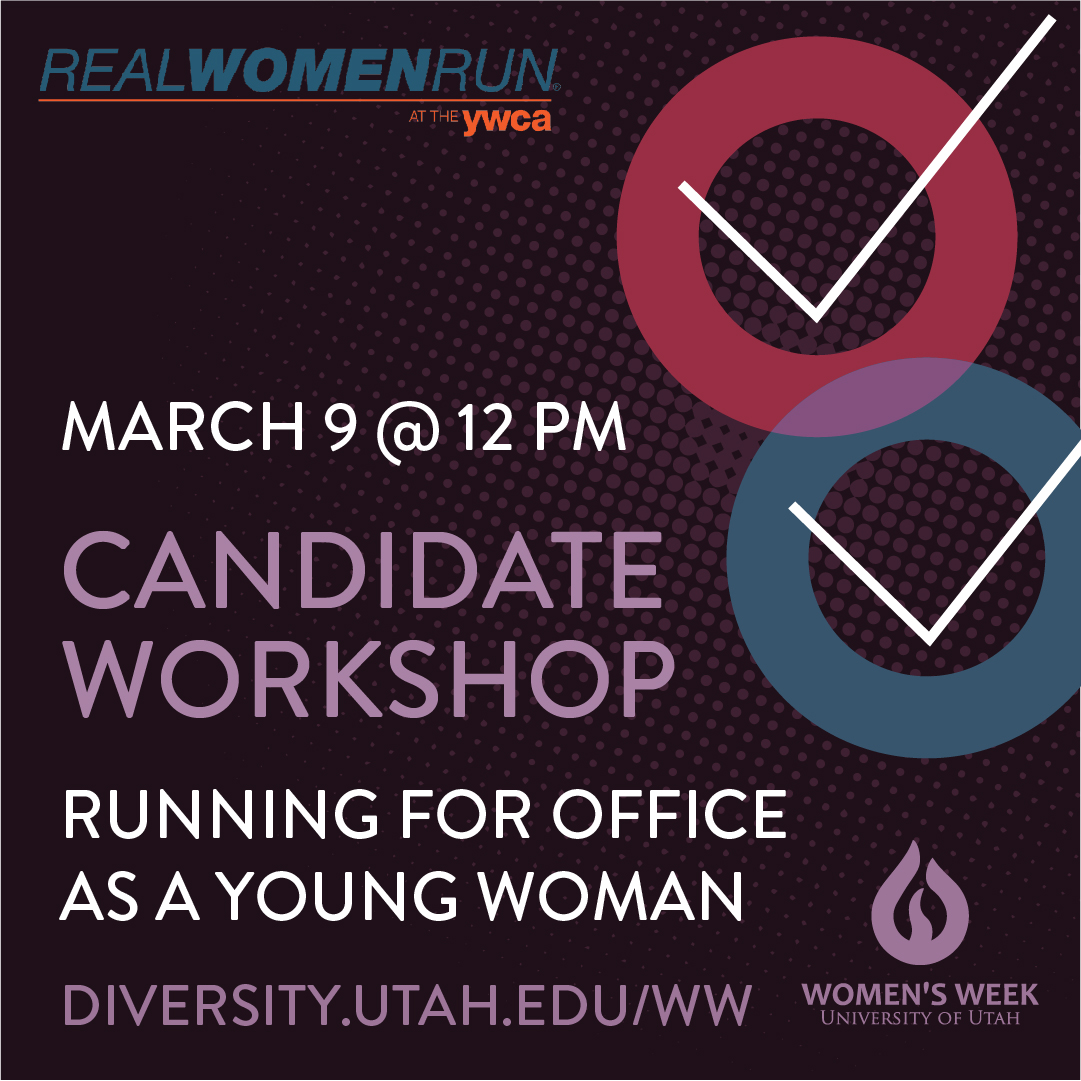
I have been honored to take on the role as committee chair for the University of Utah’s Women’s Week Committee. For the past ten years, this has emerged as an inspiring list of events that honors womxn, celebrates womxn, and recognizes the important work of womxn leaders. This year’s theme is entitled, “Inspiring a Movement” where we take queue from women leaders to imagine our own leadership roles within – that movements paving the way for societal change have been deeply inspired by womxn leading the way. I am a huge Amber Ruffin fan and was over the moon when she agreed to be our keynote. In addition to hearing from Ruffin, our week of events will include workshops on women who run, leadership workshops from health sciences, we will hear from women in office, and end the week with healing and moving the needle – literally and with visions for social change.

https://diversity.utah.edu/ww/

Human Rights: Fair Food at the Kitchen Table

National Underground Railroad Freedom Center

Friday, January 22, 2021 | 2:00 pm – 3:00 pm

Location

Online Via Zoom

Event Type

Panel Discussion, Online

Cost

Free

The agricultural industry has many historical ties to slave economies of the past including the demand for cheap labor and commodities. In fact, migrant farm work continues to be one of the most exploited labor sectors in the United States. Migrant labor has been essential for the agricultural industry in western states such as California and Oregon as well as the Mid-West and across the nation. This discussion will focus on the experiences of migrant farm workers to better understand how their working conditions and rights are central to combating human trafficking and ensuring a just food system. Experts will discuss the legacies of slave economies and immigration law on contemporary migrant farm workers’ rights as well as the ongoing farmworker civil rights movement to ensure their fair treatment. The discussion will also highlight the ongoing work of the Coalition for Immokalee Workers, an internationally recognized farmworker organization, and feature two anti-trafficking scholar-activists.  Participants will learn about how the struggle for fair wages, work safety, and the human rights of farm workers is central to combating unfreedom today.

The Coalition for Immokalee Workers is a worker-based human rights organization internationally recognized for its achievements in fighting human trafficking and gender-based violence at work.  The CIW is also recognized for pioneering the design and development of the Worker-driven Social Responsibility paradigm, a worker-led, market-enforced approach to the protection of human rights in corporate supply chains. Two CIW speakers will join the webinar, Uriel Zelaya-Perez and Silvia Perez.

Dr. Jennifer Suchland is a scholar-activist and associate professor at Ohio State University with over a decade of research and advocacy experience in human trafficking and critical human rights. Her expertise in legal and feminist studies focuses on the intersections between economic, gender, and racial justice. She currently is an ACLS/Mellon Foundation Scholars & Society fellow (2020-2021) at the National Underground Railroad Freedom Center collaborating on a project entitled Abolition Today.

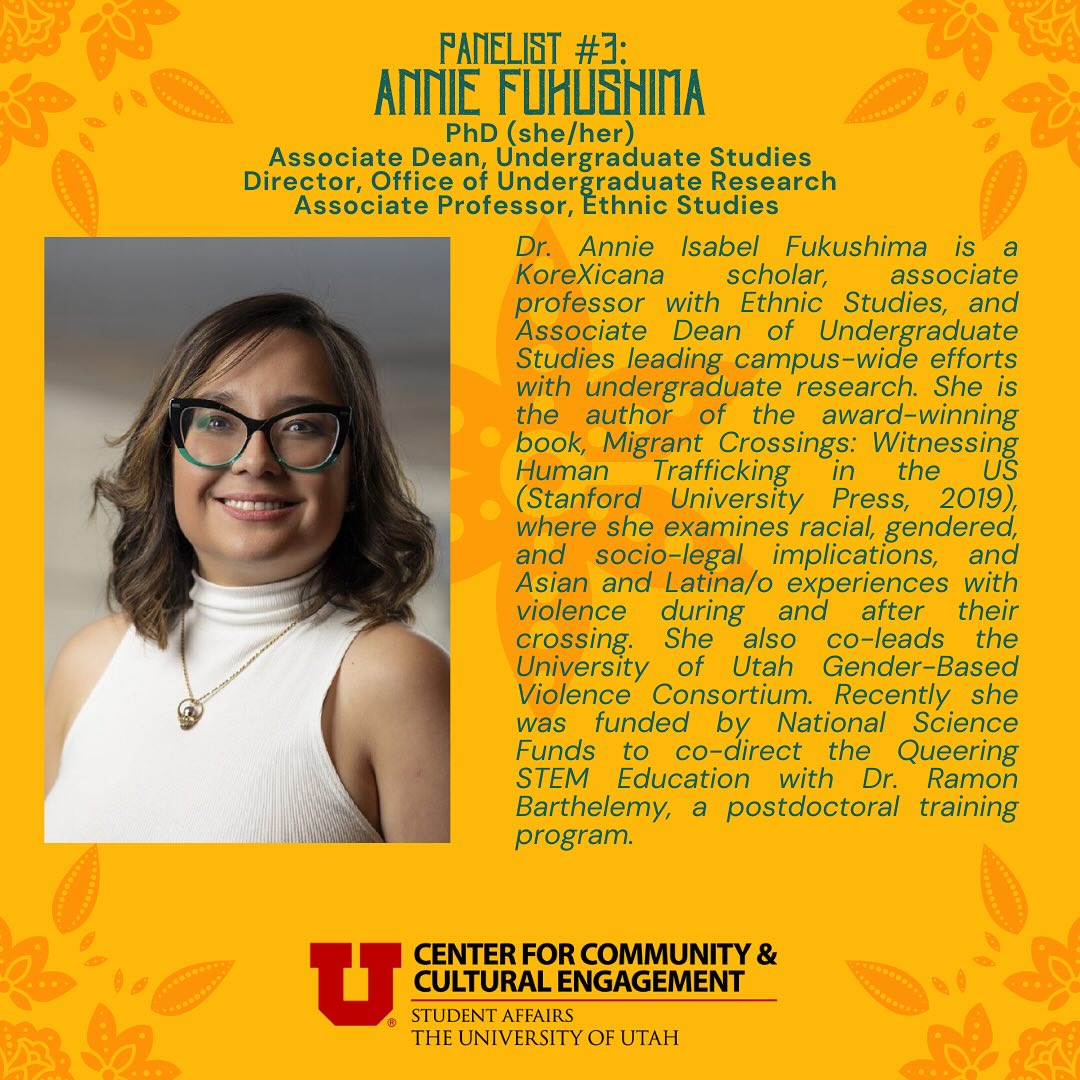
Dr. Annie Isabel Fukushima is a KoreXicana scholar-activist and assistant professor at the University of Utah with expertise is in labor, migration, and human trafficking. She has published widely on these topics including her recent award-winning book, Migrant Crossings: Witnessing Human Trafficking in the U.S. In addition to her extensive scholarship, she is a frequent community consultant on issues relating to human trafficking and migrant rights and is a member of the Freedom Network.

Registration is required:

https://zoom.us/webinar/register/WN_zPDBx8EPRoWE33Y2xYxwpA

American Sociological Association 2021 – Special Session

Missing and Murdered: Women of Color, Transgender, and Indigenous People
(Session Organizer) Annie Isabel Fukushima, University of Utah; (Presider) Annie Isabel Fukushima,
University of Utah


This thematic session grapples with a social phenomenon of missing and murdered people – in particular, how state‐based violence coheres with gender‐based violence in what is referred to as feminicidio, femicide, feminicide and murder. This session will offer an analysis through state comparisons; in particular, the Mexican and Guatemalan state’s response to feminicidio with that of the U.S. and Canadian state’s response to femicide, to underscore the role of the state in responding to the crisis of missing and murdered Indigenous women and girls. And in particular, what is known about death through the organizational responses, such as the Canadian Femicide Observatory for Justice and Accountability. This session will also provide an intersectional analysis that reconciles the complexity of sex/gender/sexuality systems as they relate to gender‐based violence and murder, through the exemplar of the murder of transgender people in the United States. Panelists answer the following questions: What are the patterns and phenomena that a sociology of gender may facilitate to better understand gender‐based violence that leads people to be considered “missing” or “murdered”? How do states respond to missing and murdered people, and what are the role of social structures, specialized and traditional justice systems in facilitating (in)action? How may sociological engagement with systems and social movements, through the subject of missing and murdered people, deepen methodology and sociological inquiry? This panel brings together leading social scientists whose contributions bridge together sociology of the law, transnational feminist theory, legal studies, feminist anthropology, and intersectionality. The panelists work from various methodological and analytical approaches.

  • Missing from the count: Visualizing the invisible victim in fem[in]icide data, Myrna Dawson, University of Guelph
  • Intersectionality and Impunity: A comparative analysis of feminicidio in Mexico and the crisis of missing and murdered Indigenous women in Canada, Paulina Garcia del Moral, University of Guelph
  • Guatemala and Mam indigenous refugee women, gender‐based violence and feminicidio, and access to justice in Guatemala and in U.S. immigration courts, Lynn Stephen, University of Oregon
  • Unequal Risk: Intersections of Race, Gender, and Sexuality in the Murders of Transgender People, Laurel Westbrook, Grand Valley State University

https://www.asanet.org/annual-meeting-2021/invited-sessions

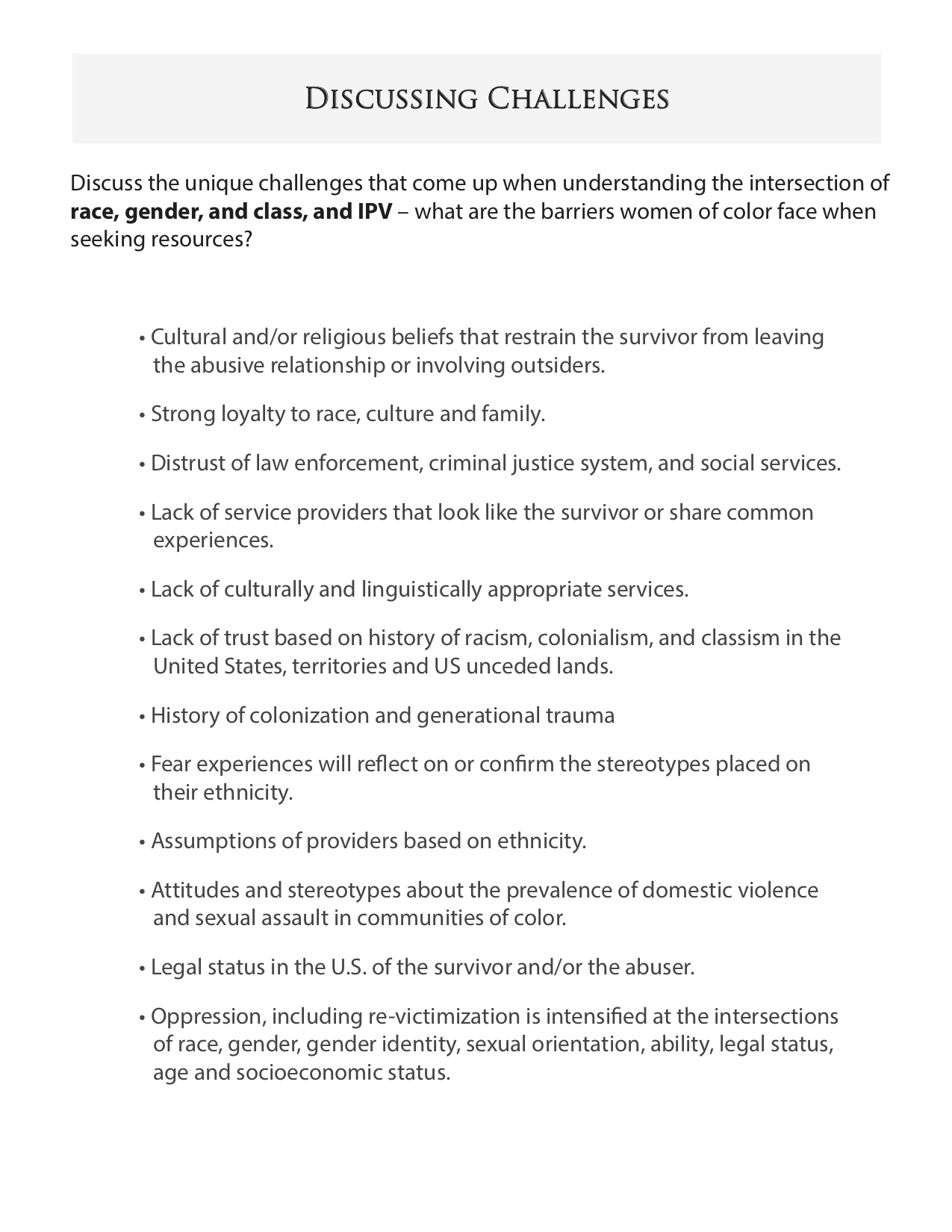
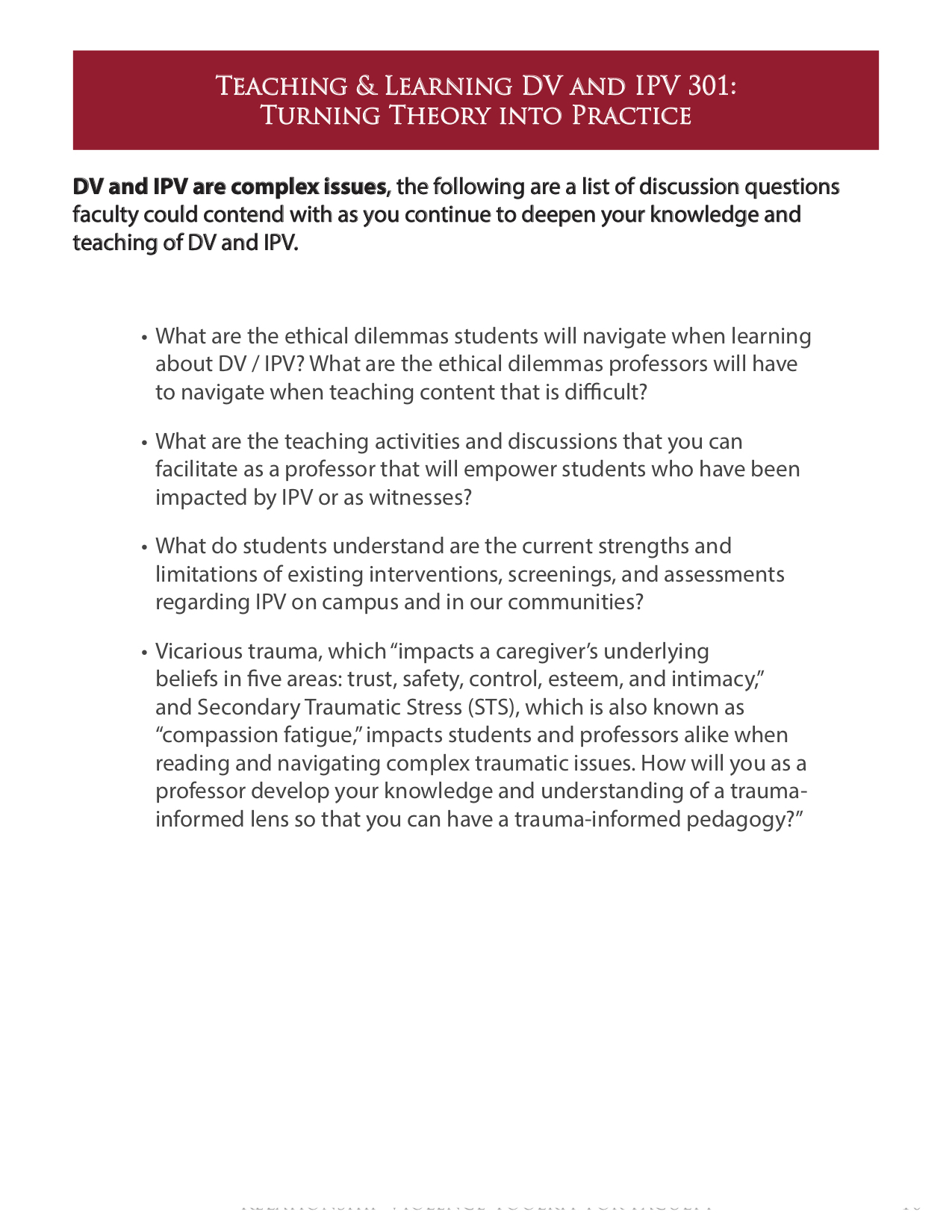
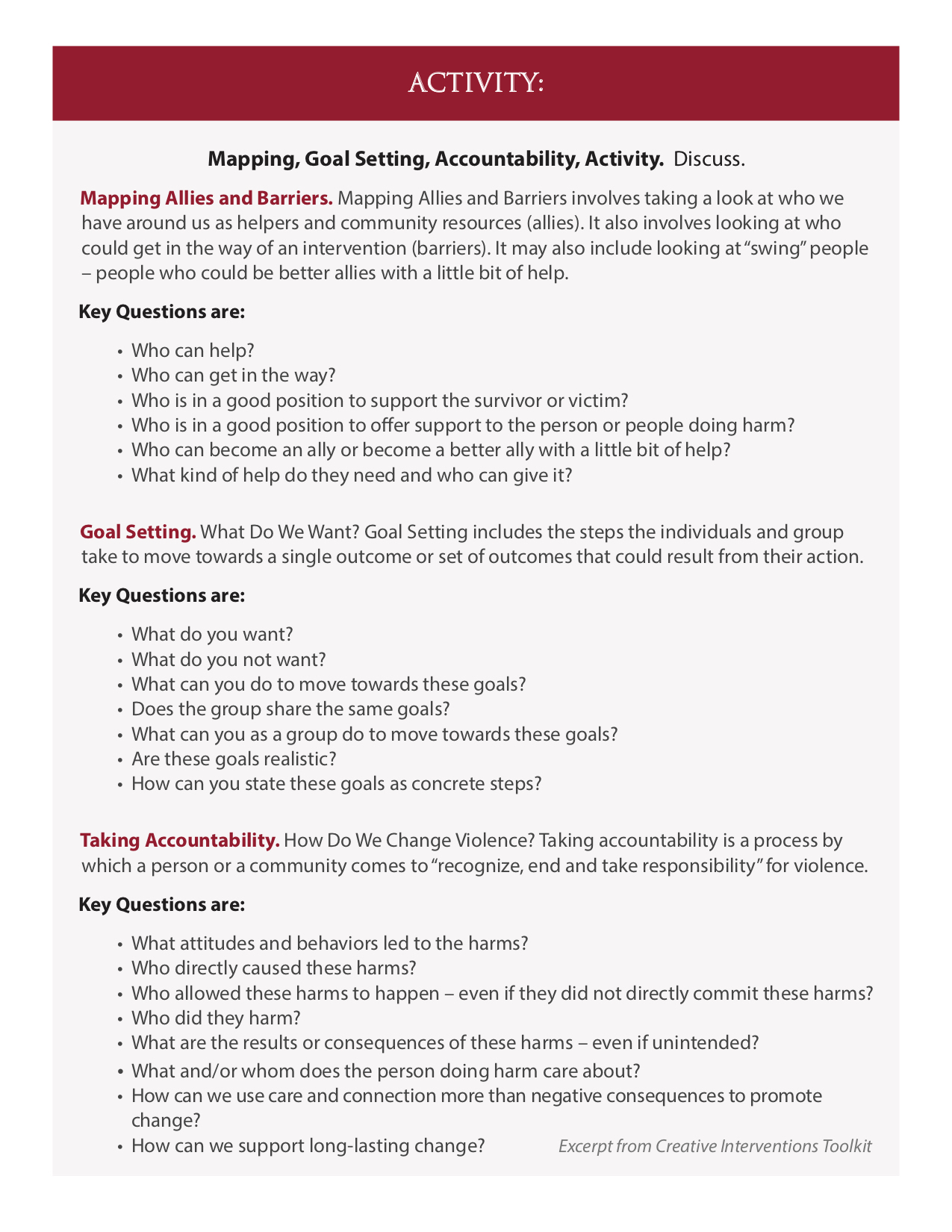
Relationship Violence Toolkit for Educators

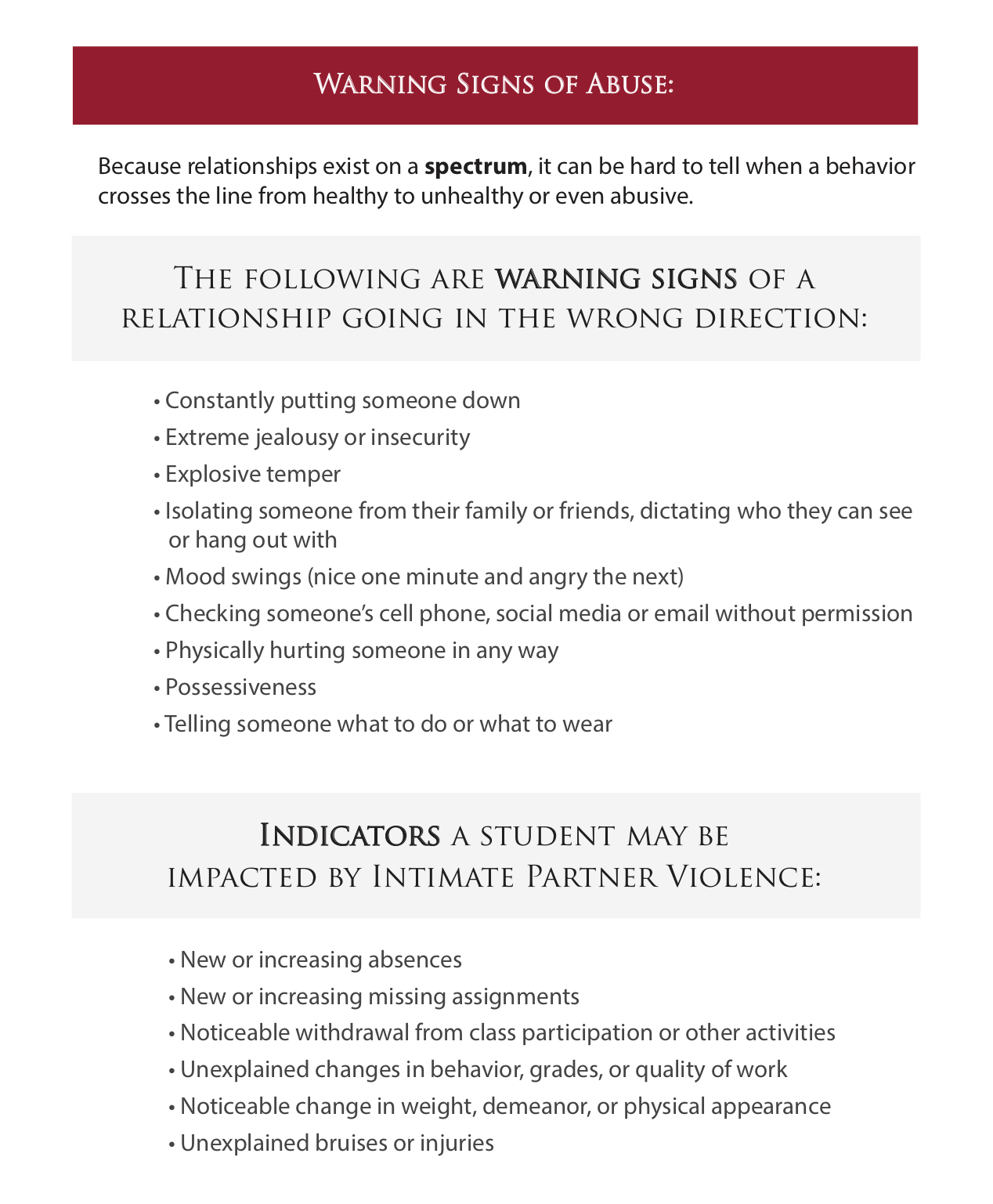
During #DVAM2020 the University of Utah’s Gender-Based Violence Consortium partnered with Fight Against Domestic Violence to create the “Relationship Violence Toolkit for Educators.” The toolkit is for educators, where content is organized to include suggestions for teaching from those new to the issues (101) to those more advanced in their knowledge (201 and 301).

The Gender-Based Violence Consortium at the University of Utah brings together an interdisciplinary team of scholars representing multiple colleges across campus. The consortium is an inter-professional collaboration, a campus scholarly network that embodies an academic commitment to sharing knowledge, supporting long-term collaborations through research hubs, creating programming, sharing teaching and responding to gender-based violence in Utah.

The mission of Fight Against Domestic Violence is to generate resources for domestic violence survivors and service providers through corporate, individual, and community partnerships.

Special acknowledgements to the authors and co-creators of the toolkit: Brooke Muir (Fight Against Domestic Violence), Heather Harris, Dr. Jessie Lynn Richards (University of Utah), Dr. Annie Isabel Fukushima (University of Utah), and Diane Le Strain (University of Utah).

To receive updates about gender-based violence, learn more about how you may be involved, please contact Dr. Annie Isabel Fukushima gbvc@utah.edu.

Title IX

Know Your IX

ACLU Title IX Fact Sheet

Summary of Title IX Final Rule

NVRDC Fact Sheet about new Title IX Regulations

Links for Title IX Coordinators & Reporting Procedures for students

University of Utah

Brigham Young University

Utah State University

Utah Valley University

Dixie State University

Salt Lake Community College

Snow College

Southern Utah University

Weber State

Westminster College

Issues students face:

  • Confidential v. nonconfidential resources
  • Roles of mandated reporters – students, faculty, staff
  • Student legal representation, particularly low-income survivors
  • Safety v. prevention initiatives
  • Re-traumatization

Resources

Professors’ Experiences With Student Disclosures of Sexual Assault and Intimate Partner Violence: How “Helping” Students Can Inform Teaching Practices
Branch, Kathryn A ; Hayes-Smith, Rebecca ; Richards, Tara N
Feminist Criminology, 2011-01, Vol.6 (1), p.54-75

Survivors of Gendered Violence in the Feminist Classroom
Lee, Janet
Violence Against Women, 2008-12, Vol.14 (12), p.1451-146

Seeing Life in their Shoes: Fostering Empathy Toward Victims of Interpersonal Violence through Five Active Learning Activities
Clevenger, Shelly ; Navarro, Jordana N ; Gregory, Lydia K
Journal of Criminal Justice Education, 2017-07-03, Vol.28 (3), p.393-410

https://www.utcourts.gov/abuse/protective_orders.html

https://www.niwrc.org/resources/fact-sheet-cdc-violence-against-american-indian-and-alaska-native-people

https://www.niwrc.org/resources/fact-sheet-cdc-violence-against-american-indian-and-alaska-native-people

https://healthymarriageandfamilies.org/resources/media-gallery/webinars/working-asian-american-individuals-couples-and-families-webinar

https://nationallatinonetwork.org/images/files/NO_MAS_INFOGRAPHIC.pdf 

https://nationallatinonetwork.org/images/Latin_DV_Stats.pdf

doj.state.or.us/wp-content/uploads/2017/08/women_of_color_network_facts_domestic_violence_2006.pdf 

https://wocninc.org/wp-content/uploads/2018/11/DVFAQ-1.pdf

How to Support

Utah’s Domestic Violence Coalition

YWCA of Utah

Utah Coalition Against Sexual Assault

Rape Recovery Center Crisis Line 801-467-7273 

Love Is Respect

Campus Resources

Safe U

Advocacy/Mental Health

Contact a Victim Advocate advocate@sa.utah.edu

University Police 801-585-2677

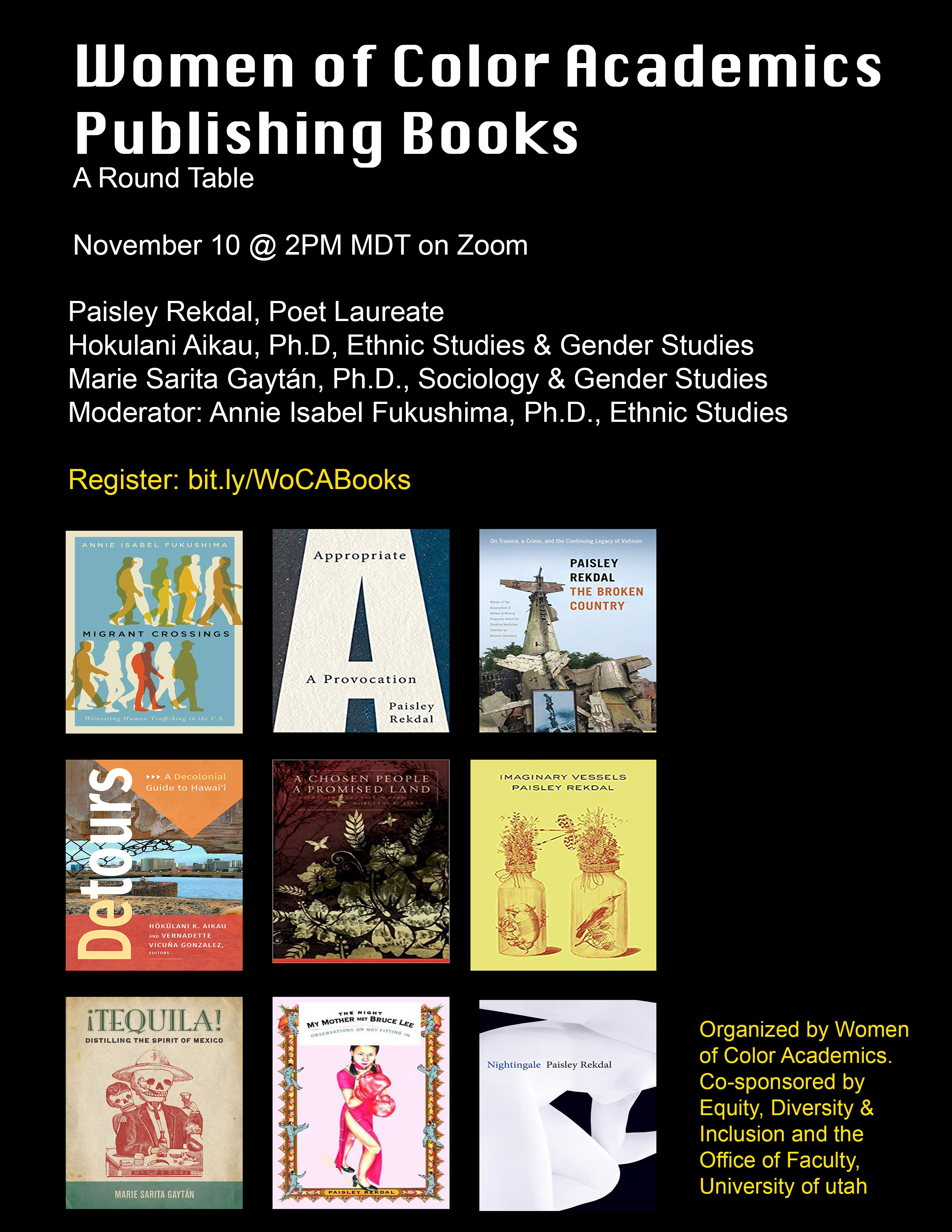
Research and Publishing during Covid-19

Utah State University

Tuesday, November 10th

12:00 – 1:00 pm MST

Location: Zoom
Register: https://usu.co1.qualtrics.com/jfe/form/SV_6ssyCVgldSXSGhL

This discussion will explore the impact of the COVID-19 pandemic on scholarly research and publishing. Travel restrictions, retracted funding, delayed or halted projects, and an increase in caretaker and other personal responsibilities at home compound to create unprecedented  challenges for producing and publishing research. Early indicators show women, those with significant unpaid care responsibilities, and members of minoritized groups have been disproportionately impacted. For graduate students and early career faculty who depend on research and publication for promotion and tenure, the stakes are especially high. Join our panelists for a conversation about the how the COVID-19 pandemic is impacting the research landscape.

Panelists:

  • Dr. Avery Edenfield, Assistant Professor, English, USU 
  • Dr. Annie Isabel Fukushima, Assistant Professor, Ethnic Studies, University of Utah 
  • Becky Thoms, Head of Digital Initiatives, Merrill-Cazier Library, USU 
  • Dr. Elizabeth Vargis, Associate Professor, Biological Engineering, USU 

Questions? Contact Rachel Wishkoski, USU Libraries: rachel.wishkoski@usu.edu or (435) 797-5371

WITNESSING GENDER-BASED VIOLENCE ACROSS BORDERS

Title: Witnessing Gender-Based Violence Across Borders

Symposium: Sex, Gender, and Women’s Health Across the Lifespan, Virtual Symposium:
Presenter: Annie Fukushima, PhD, University of Utah
Date: 5/14/20
Brief Description: Discussing gendered violence across various types of borders
Keywords/Main Subjects: Borders, gender-based violence, domestic violence
Copyright: copyright Annie Fukushima ©2020
Contact: a.fukushima@utah.edu

Video Available: Migrant Crossings Book Launch Panel with AAADS and Eastwind Books

Eastwind Books of Berkeley and Co-sponsors UC Berkeley Asian American and Asian Diaspora Studies, Asian Pacific American Students Development, University of California, Berkeley Event.

ZOOM Panel discussion about Migrant Crossings: Witnessing Human Trafficking in the U.S. by Annie Isabel Fukushima (Author) 

Guest panelists:

Cindy C. Liou, Esq. is the State Policy Director at Kids in Need of Defense (KIND) working to provide legal counsel to unaccompanied refugee and immigrant children in the United States. 

Carolyn Kim is the Managing Attorney at Justice At Last and specializes in legal advocacy for survivors of all forms of human trafficking located in the Bay Area. 

Hediana Utarti is the Anti-Trafficking Program Coordinator/Community Advocate at San Francisco Asian Women’s Shelter

For more information contact www.asiabookcenter.comeastwindbooks@gmail.com

Author Meets Readers with Annie Isabel Fukushima – October 28

Join me, the Tanner Humanities Center at University of Utah, and Transform with panelists Caren Frost, Sarita Gaytan, Erika George moderated by Edmund Fong. We will reflect on my book and celebrate that I received a book award from American Sociological Association section on Asia and Asian America.


October 28, 2020 @ 4PM PDT / 5PM MDT / 7PM EDT

https://www.eventbrite.com/e/author-meets-readers-with-annie-isabel-fukushima-tickets-125264905705

WiHMS Webinar: Fighting Gender-Based Violence

October 7th 3PM PDT / 4PM MDT / 6PM EDT

As the Project Lead and Co-Principal Investigator, for the University of Utah’s Gender-Based Violence Consortium, I will be joined with Dr. Marta McCrum, MD, MPH, Assistant Professor in the Department of Surgery to discuss “Fighting Gender-Based Violence.” We will share from our line of work and research the effects of gender-based violence and how to fight against it. Event hosts: Dr. Yoshimi Anzai and Dr. Leslie Halpern, Co-Directors of Women in Health, Medicine & Science.

This webinar is a part of WiHMS strategy to provide monthly events on topics that are critical to women in healthcare professions.

Registration is required: 

https://utah.zoom.us/webinar/register/WN_ocbifTf5R8Km47Ka2fUecw

Decolonial Feminist Praxis: Centering knowledge & resistance at the margins Edited Anthology – Call for Submissions.

bit.ly/DecolonialFeministPraxis

Dr. Annie Isabel Fukushima & Dr. K. Melchor Hall, Editors Editors: Drs. Annie Isabel Fukushima and K. Melchor Hall

Knowledge production occurs in a range of institutional apparatuses: education, political, religion, legal, cultural, and media and communication based. Through these institutions, subjects are disciplined into citizens, where colonial logics of “us” versus “them” take hold. As global pandemic, environmental catastrophe, political oppression, ongoing state-based violence and uncertain futures occur, it is ever more pressing that communities cohere to share the modalities and visions that make possible insurgent knowledge and praxis. As foregrounded in the Feminist Freedom Warriors collaborative book (2018) and web archive (http://feministfreedomwarriors.org/) of Chandra Talpade Mohanty and Linda Carty, feminist scholars, organizers, and activists must “sustain radical struggles against neoliberal, transnational capital, carceral, national-security-driven nation-states, and the rise of racist, right-wing, authoritarian regimes in the United States and around the world.” Mohanty and Carty foreground “the urgency of a decolonial, anti-capitalist, anti-racist resistance,” that is “building coalitions and solidarity across struggles.” Mohanty and Carty (2018) highlight how feminist freedom warriors engage resist and build coalitions with an imaginative and courageous spirit. This anthology will be curated attention to this kind of a feminist praxis.

As Chandra Talpade Mohanty conveyed, emancipatory knowledge is “communally wrought.” And a genealogy of scholars and practitioners have shaped the way revolutionary thinking and methodologies have been thought, the relationship between colonization and the archive, and the radical possibility in transnational feminist organizing. We have learned from the Feminist Freedom Warriors that, “because communities struggle on the basis of ideas and visions of justice and equity, the intellectual and political work of knowledge production is always key to all forms of social movements and resistance.” As the Feminist Freedom Warriors paved a way to illuminate a genealogy of thinking and praxis, this call for proposals invites community organizers, activists, scholars who choose the life of the precariat, feminist scholar-activists disrupting and shifting the margin to the center, and anyone who seeks to imagine a decolonial future through insurgent knowledge creation, resistance, and decolonial praxis.

Drs. Annie Isabel Fukushima and K. Melchor Hall, editors of the anthology, are former fellows of the Democratizing Knowledge Summer Institute. Dr. Fukushima is a KoreXicana scholar-activist, author of award-winning book Migrant Crossings: Witnessing Human Trafficking in the US, Co-Principal Investigator for the University of Utah’s Gender-Based Violence Consortium, and Co-Lead for the Institute of (Im)Possible Subjects Migratory Times, a collaboration with the Center for Arts Design and Social Research. Dr. K. Melchor Quick Hall is the author of Naming a Transnational Black Feminist Framework: Writing in Darkness and host of the related transnational Black feminist online series of conversations with Black feminist artists and activists. Hall is a faculty member in the Human and Organizational Development programs at Fielding Graduate University’s School of Leadership Studies. She is also a Visiting Scholar at Brandeis University’s Women’s Studies Research Center and an instructor with Boston University’s Prison Education Program.

Drs. Annie Isabel Fukushima and K. Melchor Hall invite contributions of scholarly, creative, and visual works that share diverse modes of decolonial praxis. We invite contributors to consider the following themes:
● Activism and feminist transnational movements
● Anti-racist pedagogies, education of the commons
● Arts as resistance, arts and social change
● Communities and technologies of resistance
● Decolonized archives and historical forms of remembering
● Decolonizing food: from radical gardens to collective food-ways
● For the commons: Water, air, and the environment – knowledge and ancestors
● Responding to state violence through radical epistemologies

We invite single author, co-authored, collaborative, and collective works including but not limited to the following forms:
● Interview / dialogue
● Lexicon/vocabulary
● Manifestos
● Multimodal work
● Poetry/fiction
● Scholarly essay/article
● Testimonio

Abstracts of no more than 250 words are due September 1, 2020. Full manuscript submissions should not exceed 6,000 words, including notes and references. Format citations in Chicago style (Author date). Submit to: bit.ly/DecolonialFeministPraxis. Full submissions are due December 31, 2020. Critical to a decolonizing and feminist knowledge praxis is dialogue and collective sharing. Therefore, accepted submissions will be invited to participate in a virtual dialogue with the editors and Democratizing Knowledge Institute fellows and faculty during the month of March 2021. After receiving collective feedback, authors will be invited to submit a revised and final draft for publication June 1st, 2021.

Questions? Email: a.fukushima@utah.edu and kmhall@fielding.edu

2020 Award Recognition from ASA Section on Asia and Asian American

Today, please join me – I am receiving the American Sociological Association’s Section on Asia and Asian America 2020 Book Award on Asian America.

What an honor to be recognized by my colleagues. I hope other scholars who deeply think through race, gender, and violence will see the centrality of addressing such issues through interdisciplinary frames and methodologies. Solutions to real world social dilemmas means being inspired through a praxis of witnessing, and through an ethnic studies methodology of the bricoleur.

4:30PM PDT, August 8th @ the ASA AAA Business Meeting, Virtual Engagement Event

Registration for the Virtual Engagement Event is free for ASA members and $25 for non-members. If you registered for the in-person ASA Annual Meeting as a member, your registration fee has been refunded and your registration remains valid. https://www.asanet.org/annual-meeting-2020/registration

University of Utah GBVC covered in the Salt Lake Tribune

Thank you to Becky Jacobs and the Salt Lake Tribune for covering the University of Utah’s Gender-Based Violence Consortium. So appreciative of the coverage to raise visibility about the consortium. Not only is it informational, but Jacobs shares resources for survivors who may be reading content and experiencing violence. Raising awareness as one is raising consciousness.

Visit the link to read the full article.

University of Utah researchers team up to study gender-based violence in state

by Becky Jacobs

https://www.sltrib.com/news/2020/07/19/university-utah/

The role of technology

The role of technology in human trafficking and anti-trafficking by GAATW

This is a recording of the webinar titled “The role of technology in human trafficking and anti-trafficking” that GAATW organised on 8 June 2020. The speakers – scholars and advocates in the areas of human rights, migration, women’s rights, sex workers’ rights and human trafficking – discuss common myths and misconceptions about the role of technology in human trafficking and anti-trafficking. Their interventions are based on recent research published in the journal Anti-Trafficking Review. The materials discussed in the webinar can be found here: https://gaatw.org/ATR/AntiTraffickingReview_issue14.pdf

Jennifer Musto, Mitali Thakor and Borislav Gerasimov, ‘Editorial: Between Hope and Hype: Critical evaluations of technology’s role in anti-trafficking’,

Dr Sanja Milivojevic, Heather Moore and Marie Segrave, ‘Freeing the Modern Slaves, One Click at a Time: Theorising human trafficking, modern slavery, and technology’,

Stephanie A. Limoncelli, ‘There’s an App for That? Ethical consumption in the fight against trafficking for labour exploitation’,

Dr Laurie Berg, Bassina Farbenblum and Angela Kintominas, ‘Addressing Exploitation in Supply Chains: Is technology a game changer for worker voice?’,

Dr Annie Isabel Fukushima, ‘Witnessing in a Time of Homeland Futurities’,

Samantha Majic, ‘Same Same but Different? Gender, sex work, and respectability politics in the MyRedBook and Rentboy closures’,

Danielle Blunt and Ariel Wolf, ‘Erased: The impact of FOSTA-SESTA and the removal of Backpage on sex workers’,

Isabella Chen and Celeste Tortosa, ‘The Use of Digital Evidence in Human Trafficking Investigations’,

Kate Mogulescu and Leigh Goodmark, ‘Surveillance and Entanglement: How mandatory sex offender registration impacts criminalised survivors of human trafficking’,

ESSENTIAL LATINX EDUCATORS: TEACHING IN A TIME OF PANDEMIC

By Leticia Alvarez GutiérrezAnnie Isabel Fukushima and Marie Sarita Gaytán

COVID-19 continues to take a disproportionate toll on Latinxs because many have low-paying jobs that require them to interact with the public as “essential workers.” Given their roles in critical industries, Latinxs and other people of color are dying of COVID-19 at higher rates in comparison to their white counterparts.[1] Latinxs face contradictions as “liminal” citizens navigating in-between statuses along an indispensable (essential) and dispensable (expendable) continuum. This is what Cecilia Menjívar (2006) describes as “liminal legality,” a method used by governments to keep immigrants’ legal status undetermined. Purposefully ambiguous, it is meant to create economic and legal precarity. Undocumented immigrants are especially impacted; the government hails them as “essential,” yet fails to provide adequate health coverage, denies access to federal relief programs, and refuses to halt deportations. Although Latinxs range in legal status, they bear the brunt of pandemic.[2] Additionally, 65% of Latinxs experienced pay cuts or layoffs since the onset of COVID-19 stay-at-home orders.[3] Consequently, the effects of living in liminality are reverberating across Latinx families and communities. For Latinx educators, staff and students, questions loom about fall classes during the pandemic.

As the Latinx community continues to confront structural inequities present long before the COVID-19 outbreak (think: employment, health care, housing, safety, and immigration needs), what is the role of Latinx educators during pandemic? As Indigenous Latina/Purépecha/Chicana (Alvarez Gutiérrez), Asian-Latina / KoreXicana (Fukushima), Latina/Chilean/Irish (Gaytán) first-generation professors in the state of Utah, we view our role as essential educators. We are mindful of the stakes of being called on to work – in the classroom as educators – and the unease of teaching and learning while the global pandemic accelerates. [4]

Latinx Talk

Read the entire article by visiting Latinx Talk:

https://latinxtalk.org/2020/07/06/essential-latinx-educators-teaching-in-a-time-of-pandemic/?fbclid=IwAR1lnvonuJMrBzJnpFBFoS1YuHRYb3AispIYsuc2TeaHCBz7Jk6OvPTQkd8

ZOOM Author and panel discussion Migrant Crossings: Witnessing Human Trafficking in the U.S.Annie Isabel Fukushima (Author)

IMMEDIATE PRESS RELEASE. Please share.

image.png

Eastwind Books of Berkeley and Co-sponsors UC Berkeley Asian American and Asian Diaspora Studies, Asian Pacific American Students Development, University of California, Berkeley present:

July 26, 2020 Sunday 3PM pst

ZOOM Author and panel discussion Migrant Crossings: Witnessing Human Trafficking in the U.S.Annie Isabel Fukushima (Author) 

Guest panelists:

Cindy C. Liou, Esq. is the State Policy Director at Kids in Need of Defense (KIND) working to provide legal counsel to unaccompanied refugee and immigrant children in the United States. 

Carolyn Kim is the Managing Attorney at Justice At Last and specializes in legal advocacy for survivors of all forms of human trafficking located in the Bay Area. 

Hediana Utarti is the Anti-Trafficking Program Coordinator/Community Advocate at San Francisco Asian Women’s Shelter

For more information contact www.asiabookcenter.comeastwindbooks@gmail.com

Eastwind Books of Berkeley – Homewww.asiabookcenter.comLOCAL INDEPENDENT BOOKSTORE SELLING ASIAN AMERICAN, LANGUAGE LEARNING, CHINESE MANDARIN, MARTIAL ARTS, TRADITIONAL CHINESE MEDICINE BOOKS, QIGONG BOOKS, ART SUPPLIES, CHINESE PHILOSOPHY, EASTERN RELIGIONS, ETHNIC STUDIES

Free Ticket RSVP https://www.eventbrite.com/e/book-launch-and-panel-migrant-crossings-tickets-111498525090

image.png

Migrant Crossings examines the experiences and representations of Asian and Latina/o migrants trafficked in the United States into informal economies and service industries. Through sociolegal and media analysis of court records, press releases, law enforcement campaigns, film representations, theatre performances, and the law, Annie Isabel Fukushima questions how we understand victimhood, criminality, citizenship, and legality.
Fukushima examines how migrants legally cross into visibility, through frames of citizenship, and narratives of victimhood. She explores the interdisciplinary framing of the role of the law and the legal system, the notion of “perfect victimhood”, and iconic victims, and how trafficking subjects are resurrected for contemporary movements as illustrated in visuals, discourse, court records, and policy. Migrant Crossings deeply interrogates what it means to bear witness to migration in these migratory times–and what such migrant crossings mean for subjects who experience violence during or after their crossing.

Dr. Annie Isabel Fukushima is Assistant Professor in the Ethnic Studies Division in the School for Cultural and Social Transformation at the University of Utah. Her research covers issues of migration, violence, race, gender, and witnessing and her expertise is recognized across the U.S. Dr. Fukushima’s scholarly works appear in numerous peer-reviewed journals. She values praxis, having implemented community-based research projects and served as an expert witness on human trafficking for immigration, civil, andcriminal cases in multiple US states, including California. Publicity Material Migrant Crossings(Stanford University Press, 2019) 9781503609495Recipient of the American Sociological Association Section on Asia and Asian America’s Book Award on Asian Americaanniefukushima.comPublications

https://www.facebook.com/events/579302892786645/

Contact
Eastwind Books of Berkeley
2066 University Avenue; Berkeley, CA 94704
phone: 510 548-2350 fax: 510 548-3697
www.asiabookcenter.com  email: eastwindbooks@gmail.com

Mapping gender-based violence

By Morgan Aguilar

A group of nine University of Utah researchers hopes to increase public recognition of gender-based violence (GBV) through the Gender-based Violence Consortium. The interdisciplinary team of scholars represents multiple colleges across campus who came together to apply for a seed research grant from the vice president of research and the One U for Utah (IU4U) grant. The IU4U initiative is designed to seed faculty collaborations in areas of mutual research interest and opportunity.

“It was very striking to me that many of us have been doing work around gender-based violence issues but we had never been in the same room together,” said Annie Isabel Fukushima, a professor of ethnic studies in the School for Cultural and Social Transformation and the project owner of the GBV Consortium. “The One U for U program helps create that infrastructure for us to collaborate.”

Read full length article here at this Source: Mapping gender-based violence

Food Matters: Trafficked Transnational Migrants’ Experiences and the Matrix of Food (In)Security

Annie Isabel Fukushima Journal of Human Rights Practice, huaa024, https://doi.org/10.1093/jhuman/huaa024

Published: 24 June 2020

https://doi.org/10.1093/jhuman/huaa024

Abstract
This article traces a particular object, food, in the context of the human rights violation of human trafficking of transnational migrant labourers, to answer: how does food come to matter for transnational migrants who labour in the United States and experience abuse in the form of human trafficking? To answer the research question, this article employs a qualitative method—thematic analysis of human trafficking court complaints in the legal system (N¼133). Through scavenging legal complaints made by transnational migrant labourers in the United States between 2000 and 2017, the author provides a novel framework: a matrix of food (in)security. A matrix of food (in)security is a framework describes how food is socially, politically, and legally articulated in transnational migration: food as a weapon of abuse, food (in)security, and workers in a food chain.
Keywords: abuse; food chains; food insecurity; human trafficking; immigration; labour

Book Review of Migrant Crossings – in Humanity & Society

I want to share the review of Migrant Crossings. Deep appreciation to Dr. Ceron-Ananya at Leigh University. Some highlights of the review:

“Migrant Crossings offers an anti-racist, feminist, and decolonial analysis of the act of crossing borders, particularly concerning violence and human trafficking. In the current world, where the voices calling for higher walls and stricter policies against documented and undocumented migrants are on the rise, Migrant Crossings seeks to emphasize the colonial tropes that dominate most narratives about migration, even the good ones. The book uses multiple legal cases to demonstrate how gender, class, and racial dynamics profoundly informed the binary paradigms—that is, victim/ criminal, legal/illegal, and honorable/deviant—through which migration is understood in the United States and the West. The book invites the reader to develop new forms of seeing and witnessing the highly complex issues of migration and human trafficking” (pp. 237 – 238).

“Overall, the book draws from multiple theoretical traditions that will require scaffolding when assigning it to undergraduate students. The book, however, will be an appropriate reading for graduate courses on immigration, human rights, gender, women studies, global economy, ethnic studies, and criminology. For policymakers, it raises important considerations of how implicit theories and assumptions translate into discriminatory practices, even as we set out to liberate those we have identified as victims” (p. 239).

Ceron-Ananya, H. (2020). Book Review: Migrant Crossings: Witnessing Human Trafficking in the US, Humanity & Society, 44(2), 237 – 239.
https://doi.org/10.1177/0160597620914447

The Sociology of Human Rights and COVID-19.

Footnotes: A publication of American Sociological Association’s May/June 2020 special issue is a Special Issue: Sociologists and Sociology during COVID-19. My co-authored article, “The Sociology of Human Rights and COVID-19,” is included; this submission is co-authored with Joachim J. Savelsberg, an amazing human rights sociologist at University of Minnesota.

Four axioms show the effect of the COVID-19 situation on human rights and the relevance of the sociology of human rights in the current era. Each axiom is followed by U.S. (Fukushima) and global (Savelsberg) illustrations.


“World”-Making and “World”-Travelling with Decolonial Feminisms and Women of Color

Guest Editors’ Introduction by Wanda Alarcón, Dalida María Benfield, Annie Isabel Fukushima, and Marcelle Maese

Excerpt:

Love has to be rethought, made anew.—María Lugones (1987)

We are in good company in our engagement with María Lugones. This special issue arrives soon after the 2019 anthology Speaking Face to Face: The Visionary Philosophy of María Lugones and anticipates more collections gathering various conversations and points of entry into her important decolonial feminist thought.1 We chose Lugones’s 1987 essay “Playfulness, ‘World’-Travelling, and Loving Perception” as the invitation to this conversation because of how it positions love as central to the project of coalition.2 We are so in need of both at the present moment. The importance of making political the loving relation between women of color also echoes Lugones’s early 1983 conversation with Elizabeth Spelman about feminist coalition, “Have We Got a Theory for You! Feminist Theory, Cultural Imperialism, and the Demand for ‘the Woman’s’ Voice.”3 In this innovative essay, Lugones and Spelman write in different voices and in Spanish and English, retaining the textures of their differences, to arrive at a sense of solidarity, even when as they write “[they] could not say we.”4 Lugones and Spelman appeal for a theory-making process in which theory or an account is helpful if among other qualities, “it enables one to see how parts of one’s life fit together”; it allows one to “locate oneself concretely in the world”; and “there is reason to believe that knowing what a theory means and believing it to be true have some connection to resistance and change.”5 Theory and coalition are helpful if they not only comprehend worlds but also remake them. They also affirm friendship, not reducible to sameness nor alienated by differences, as the only viable motive for white or Anglo women to make theory with women of color. As Lugones states: “The [End Page x] only motive that makes sense to me for your joining us in this investigation is the motive of friendship, out of friendship.”6 Without these frameworks of theory, coalition, and friendship, it is difficult if not impossible, to see the politics and the practices of radical women of color writing.

We also structured our call for this special issue with language invoking another movement in Lugones’s writing, “Toward a Decolonial Feminism,” with a desire to think about the concepts of women of color and decolonial feminisms in complex interrelation.7 We take the opportunity here to amplify Lugones’s contribution to decolonial theory. Using the framework of coloniality and decoloniality elaborated by Anibal Quijano and Michael Ennis8 and many other scholars, activists, and artists, Lugones’s critical engagement with the shifting contours of women of color, the coloniality of power and gender, and decolonial feminisms produces new proposals for resistance. In “Hetero-sexualism and the Colonial/Modern Gender System,” Lugones analyzes the colonial/modern gender system and its imposition of the gender binary and heterosexualism.9 This analysis creates a new field for praxical coalition and reconstructing non-binary subjectivities outside the colonial matrix of power. Lugones also interrogates origin stories and the times and places of our pasts and futures, including a recognition of Indigenous thought and practices that persist in their resistance to coloniality. In tandem, let us also consider as a consequence, Lugones’s different way of thinking of the term “women of color” as one that expands our understanding to include women who are not “backed by a collective memory” of belonging to a legible diaspora within the United States.10 Through this deepening of women of color as a coalitional term, Lugones echoes her earlier appeal to enact what she conceives of as “world”-travelling.

“World”-travelling must not be forgotten in a praxis of decolonial feminisms. It encourages us to drop our enchantment with naturalized ideas about community and offers a pedagogy for learning “an ethics of coalitionin-the making.”11 In “Playfulness, ‘World’-Travelling, and Loving Perception,” Lugones’s loving solution to arrogant perception is accompanied with an exploration…

Visit: https://frontiers.utah.edu/

Contributions:

Your Lips: Mapping Afro-Boricua Feminist Becomings
Yomaira C. Figueroa

Decolonial Feminism as Reflexive Praxis: Lugones’s “World”-Travelling as Stories of Friendship in Academia
Jesica Siham FernándezKara HisatakeAngela Nguyen

A Decolonial Feminist Epistemology of the Bed: A Compendium Incomplete of Sick and Disabled Queer Brown Femme Bodies of Knowledge
Tala KhanmalekHeidi Andrea Restrepo Rhodes

I Love You
Tamara Al-Mashouk

Zapateado Rebelde in “Somos Sur”: A Feminist Performance of Transnational Women of Color Border Artivism
Leslie Quintanilla

On Digital Decolonization: A Conversation with Morehshin Allahyari
Abdullah QureshiMorehshin Allahyari

“World”-Travelling and Transnational Feminist Praxis in Women Who Blow on Knots
Şule Akdoğan

Tantear Practices in Popular Education: Reaching for Each Other in the Dark
Linnea Beckett

Lugones, Munóz, and the Radical Potential of (Dis)identificatory Feminist Love for “World”-Making Beyond the Academe
Andrea N. Baldwin

“Pedagogies of the Broken-Hearted”: Notes on a Pedagogy of Breakage, Women of Color Feminist Decolonial Movidas, and Armed Love in the Classroom/Academy
Anne (Anna) Ríos-Rojas

Decolonizing Identity in Performance: Claiming My Mother Tongue in Suppression of Absence
Serap Erincin

“World”-Travelling the Gloria Evangelina Anzaldúa Papers: Zooming the Cracks between Worlds
C. Alejandra Elenes

Artist Statement: The Electrics
Linda Vallejo

Migrant Crossings Receives ASA Book Award on Asian America

It is such an honor to announce that my book Migrant Crossings: Witnessing Human Trafficking in the U.S. has been selected to receive the American Sociological Association Section on Asia and Asian America’s Book Award on Asian America.

There are so many people to thank including my press and the people who birthed the project, the Ethnic Studies Division at the University of Utah, and many, many friends and family who support my work. I also want to appreciate the award committee: Drs. Emily Walton (chair), Sebastian Cherng, and Helene K. Lee;

A virtual award ceremony will be held during the AAA business meeting on Saturday, August 8, 2020, at 4:30-5:10 pm (Pacific Time) as scheduled in the ASA program. Please join us to celebrate the recipients for their achievements. 
Topic: ASA AAA Business Meeting
Time: Aug 8, 2020 04:30 PM Pacific Time (US and Canada)

Webinar – The Role of Technology in Human Trafficking and Anti-Trafficking

8 June at 8am PDT / 3 pm UTC. See more and sign up here https://bit.ly/2LBrmKW

https://platform.twitter.com/widgets.js

Sex, Gender and Women’s Health Across the Lifespan – Virtual Symposium, May 14, 2020

We are excited to be holding our first VIRTUAL Symposium on May 14 from 1-5pm: Sex, Gender and Women’s Health Across the Lifespan.  It is brought to you by the Center of Excellence in Women’s Health and the Eccles Health Sciences Library.  

Peak at the schedule:

1:00-1:15pm: Welcome and Announcements

1:15-1:45pm: The Status of Women in Utah: Education, Leadership and Well-Being

Susan Madsen, PhD: Professor of Leadership & Ethics, Woodbury School of Business, Utah Valley University

1:45-2:30pm: K12 Scholar Presentations: WRHR (Womens’s Reproductive Health Research) and BIRCWH(Building Interdisciplinary Research Careers in Women’s Health)

Nathan Blue, MD: Exploring Genetic Variation in Normal and Diseased Human Placentas

Marcela Smid,MD: Progesterone, Post-partum Women & Preventing Methamphetamine Use: Applying Maternal-Fetal Medicine’s Favorite Medicine to Perinatal Substance Abuse

Leah Owen, MD: Modeling Protection through Preeclampsia

Laura Pace, MD, PhD: The Role of Gender in the Diagnosis & Treatment of Complex Disorders

2:35-3:05pm: New Thinking on Sex, Gender, Transgender and Non-Binary Identities

Lisa Diamond, PhD: Professor, Gender Studies & Psychology, University of Utah

3:05-3:25pm: Data Blitz – presentations TBA

3:30-4:00pm: Witnessing Gender-Based Violence Across Borders:

Annie I. Fukushima, PhD: School of Cultural & Social Transformation, Div. of Ethnic Studies University of Utah

4:00-5:00pm: OB/GYN Grand Rounds Presentation:

Evidence-Based Clinical Care for Midlife Women: What do Research and Clinical Guidelines Tell Us?

Marjorie R Jenkins, MD MEdHP FACP: Dean, UofSC School of Medicine Greenville, Chief Academic Officer, Prisma Health Upstate

There is a link on the attachment, or you can REGISTER HERE

Please share this with your colleagues and students. Everyone is welcome.

(more info in attached flyer)

Call for papers: Anti-Trafficking Education: Pedagogy, Policy, and Activism

https://www.antitraffickingreview.org/index.php/atrjournal/announcement/view/27

 https://www.antitraffickingreview.org/index.php/atrjournal/announcement/view/27

2020-05-12

Anti-Trafficking Education: Pedagogy, Policy, and Activism

Guest Editors: Annie Isabel Fukushima, Annie Hill, and Jennifer Suchland

Deadline for submissions: 15 November 2020

Teaching and learning about trafficking far exceed the boundaries of the traditional student and classroom. Students range from novice to expert across various professions and industries as well as survivors of, and witnesses to, trafficking. From short-form workshops to long-term engagements, anti-trafficking education is a growing field that impacts multiple sectors, including the medical profession, social work, hospitality, travel, and law enforcement. In response to the proliferation of anti-trafficking education, this special issue of Anti-Trafficking Review will endeavour to assess, understand, and share pedagogical approaches and practices within the anti-trafficking movement.

Although anti-trafficking education is often localised, it has global and transnational implications. Educational offerings aim to cultivate a breadth of skills from identifying trafficking situations to training and supporting survivors, with impacts that not only affect practices and policies but also create knowledge about what constitutes trafficking. Programmes for survivors may be optional or mandatory and include vocational, language, or financial literacy classes. Anti-trafficking education is also institutionalised by local and national governments, and it appears in college classrooms, MOOCs (massive open online courses), and even, in some contexts, as part of legislated local responses to trafficking.

In addition to facilitating teaching and learning that prioritises trafficking interventions and survivor support, some educational strategies try to prevent human trafficking. As such, anti-trafficking education targets groups deemed at risk, particularly young people and potential migrants. For example, pre-departure trainings in Asia and Africa reveal how such interventions have grown from a public awareness focus to actualising efforts that prevent trafficking at its ‘source’.

This special issue of Anti-Trafficking Review invites scholars, activists, practitioners, survivors, and others involved in anti-trafficking education to evaluate and share how they disseminate knowledge about trafficking. In addition to generating much-needed assessments of anti-trafficking pedagogical practices, the special issue will consider how anti-trafficking education is a growing field where facts, truths, lessons, and approved interventions become established. This established (yet contested) knowledge circulates and competes for audiences and funding. Moreover, social justice projects – such as those advocating for the rights of migrants, workers, and incarcerated survivors of domestic and sexual violence, or demanding justice for murdered and missing Indigenous women – challenge racialised, gendered, colonial, and economic violence. Yet, there are tensions about whether and how anti-trafficking education diverts attention and resources away from these longstanding efforts.

We invite submissions that analyse anti-trafficking education in a variety of contexts and from diverse perspectives, as well as contributions that assess instructional materials, use or propose innovative pedagogies, and/or advocate for coalitional practices that teach about trafficking from an intersectional and cross-issue framework.

Contributors are invited to engage with, but need not limit themselves to, the following questions:

  • What are the promising practices for educating anti-trafficking stakeholders (e.g., social service and healthcare providers, lawyers, activists, community-based organisation workers, etc.) and the people deemed vulnerable to trafficking, such as migrants and youth? What obstacles, assumptions, and side effects exist, and are they addressed by instructors and instructional materials? How are instructors trained and supported to deliver educational materials on trafficking?
  • How do indigeneity, race, class, gender, nationality, and/or sexuality impact pedagogical approaches, practices, and student-instructor dynamics? Have western perspectives on human trafficking furthered imperial forms of knowing? What types of education are modelling practices that centralise indigenous and alternative ways of knowing, skill sharing, and disseminating information about human trafficking?
  • How has the development of survivor-led outreach and educational programming altered teaching and trainings on human trafficking?
  • What is the current landscape of online instruction on human trafficking? What opportunities and consequences arise when teaching in online contexts rather than in person? Additionally, what results from the proliferation of online and in-person pedagogical platforms as tools in anti-trafficking agendas?
  • What might we learn by analysing the various constituencies that are drawn to, or required to, become informed on the topic?
  • What are the goals and results of trafficking education for scholars, activists, practitioners, students, and people affected by trafficking and anti-trafficking agendas? How are goals and results measured, and how might negative effects (e.g., misinformation, re-traumatisation, misguided interventions) be mitigated against when planning and implementing educational materials and experiences?
  • How can anti-trafficking pedagogical practices connect to and reinforce longstanding social justice initiatives, such as those advocating for the rights of migrants, workers, incarcerated survivors of domestic and sexual violence, and indigenous and native sovereignty? How are trainers and educators creating and advancing anti-trafficking curricula and content in coalition with affinity movements (e.g., immigration, anti-racist, feminist, labour, etc.)? How can such education connect social justice work with other critical anti-trafficking approaches?

Deadline for submissions: 15 November 2020.

Word count for full article submissions: 5,000 – 7,000 words, including footnotes, author bio and abstract.

In addition to full-length conceptual, research-based, or case study thematic papers, we invite authors to contribute short pieces for a Forum Section on the topic of trafficking and education. We particularly encourage practitioners with diverse expertise in trafficking education to reflect on their experiences, teaching strategies, curriculum design, and/or target audiences in order to provide practical examples and advice for others in the field of trafficking education. We envision contributors potentially offering sample exercises, syllabi, or education materials as well as exploring the challenges and benefits involved in educating different groups about trafficking. 

Word count for Forum submissions: 1,000 – 1,200 words, including footnotes and author bio.

We advise those interested in submitting to follow the Review’s style guide and submission procedures, available at http://www.antitraffickingreview.org/. Manuscripts should be submitted in line with the issue’s theme. Email the editorial team at atr@gaatw.org with any queries.

Special Issue to be published in September 2021.

Multiplicity of stigma: cultural barriers in anti-trafficking response

https://www.emerald.com/insight/content/doi/10.1108/IJHRH-07-2019-0056/full/html

Annie Isabel Fukushima, Kwynn Gonzalez-Pons, Lindsay Gezinski, Lauren Clark

Abstract

Purpose

The purpose of this study is to contribute to the social understanding of stigma as a societal and cultural barrier in the life of a survivor of human trafficking. The findings illustrate several ways where stigma is internal, interpersonal and societal and impacts survivors’ lives, including the care they receive.

Design/methodology/approach

This study used qualitative methods. Data collection occurred during 2018 with efforts such as an online survey (n = 45), focus groups (two focus groups of seven participants each) and phone interviews (n = 6). This study used thematic analysis of qualitative data.

Findings

The research team found that a multiplicity of stigma occurred for the survivors of human trafficking, where stigma occurred across three levels from micro to meso to macro contexts. Using interpretive analysis, the researchers conceptualized how stigma is not singular; rather, it comprises the following: bias in access to care; barriers of shaming, shunning and othering; misidentification and mislabeling; multiple levels of furthering how survivors are deeply misunderstood and a culture of mistrust.

Research limitations/implications

While this study was conducted in a single US city, it provides an opportunity to create dialogue and appeal for more research that will contend with a lens of seeing a multiplicity of stigma regardless of the political climate of the context. It was a challenge to recruit survivors to participate in the study. However, survivor voices are present in this study and the impetus of the study’s focus was informed by survivors themselves. Finally, this study is informed by the perspectives of researchers who are not survivors; moreover, collaborating with survivor researchers at the local level was impossible because there were no known survivor researchers available to the team.

Practical implications

There are clinical responses to the narratives of stigma that impact survivors’ lives, but anti-trafficking response must move beyond individualized expectations to include macro responses that diminish multiple stigmas. The multiplicity in stigmas has meant that, in practice, survivors are invisible at all levels of response from micro, meso to macro contexts. Therefore, this study offers recommendations for how anti-trafficking responders may move beyond a culture of stigma towards a response that addresses how stigma occurs in micro, meso and macro contexts.

Social implications

The social implications of examining stigma as a multiplicity is central to addressing how stigma continues to be an unresolved issue in anti-trafficking response. Advancing the dynamic needs of survivors both in policy and practice necessitates responding to the multiple and overlapping forms of stigma they face in enduring and exiting exploitative conditions, accessing services and integrating back into the community.

Originality/value

This study offers original analysis of how stigma manifested for the survivors of human trafficking. Building on this dynamic genealogy of scholarship on stigma, this study offers a theory to conceptualize how survivors of human trafficking experience stigma: a multiplicity of stigma. A multiplicity of stigma extends existing research on stigma and human trafficking as occurring across three levels from micro, meso to macro contexts and creating a system of oppression. Stigma cannot be reduced to a singular form; therefore, this study argues that survivors cannot be understood as experiencing a singular form of stigma.

Keywords

Acknowledgements

The researchers would like to acknowledge the funds received from the Salt Lake City Mayor’s Office, Dr Jennifer Seelig, the Salt Lake City Council and the Salt Lake County District Attorney’s Office, which supported a city-wide needs assessment. The findings and recommendations presented in this article are those of the authors and do not represent the official positions or policies of the Salt Lake City Mayor’s Office, the Salt Lake City Council or the Salt Lake County District Attorney’s Offices. The authors would also like to thank the Social Research Institute of the College of Social Work at University of Utah and graduate assistance from Allison O’Connor, MSW, LCSW and Lyndsi Drysdale. Additionally, the authors are grateful to the guest editor Dr Sarbinaz Bekmuratova, the anonymous reviewers and the editorial team at the International Journal of Human Rights in Healthcare.

Citation

Fukushima, A.I.Gonzalez-Pons, K.Gezinski, L. and Clark, L. (2020), “Multiplicity of stigma: cultural barriers in anti-trafficking response”, International Journal of Human Rights in Healthcare, Vol. ahead-of-print No. ahead-of-print. https://doi.org/10.1108/IJHRH-07-2019-

Mobility & Temporality – May the 4th with Migratory Times

May 4th, 10AM PDT / 1PM EDT / 7PM CEST

Register
bit.ly/migratorytimessalon

You are invited to a Salon on Mobility & Temporality with Migratory Times. Migratory Times is a project of the Institute of (im)Possible Subjects and Center for Arts, Design and Social Research. IiS is a transnational feminist collective producing art and education events and a collectively edited online open access journal of art and writing. Center for Arts, Design and Social Research, Inc., US based non-profit 501(c)3 organization supporting independent arts, design, and research focused on positive social impact, globally.

With Crystal Baik (University of California, Riverside), Anyely Marin and Rebecca Close (Critical Dias, Spain), José Manuel Cortez (University of Oregon), Romeo García (University of Utah), Latipa (University of California, Riverside), Jackline Kemigisa (Uganda), Isabelle Massu (Institut des Beaux Arts de Besançon, France), Alejandro Perez (Berkeley City College), Jennifer Reimer (FWF Lise Meitner), Daphne Taylor-Garcia (University of California, San Diego).

Facilitators: Annie Isabel Fukushima & Dalida Maria Benfield (Migratory Times)

Mentees presenting at Undergraduate Research Symposium at University of Utah

Check out some of my mentees presenting their projects at the Undergraduate Research Symposium. #proudprofessor.

ALEXANDER HIRAI – LOSS ASSOCIATED WITH JAPANESE AMERICAN INCARCERATION

JENNY HOBBS – WOKBE: IMPLICIT BIAS WEB APP PILOT

JOCELYNE LOPEZ – HABLEMOS SALUD

https://w.soundcloud.com/player/?url=https%3A//api.soundcloud.com/tracks/798772987%3Fsecret_token%3Ds-tGUAPjJ7Gt7

VERONICA LUKASINSKI – THE IMPACT OF THE NON-FATAL STRANGULATION PROTOCOL IN SALT LAKE COUNTY ON PROTECTIVE ORDERS

ALEX SON – STRENGTHENING COMMUNITIES

“Witnessing in a Time of Homeland Futurities”

Download article: https://www.academia.edu/42871374/Witnessing_in_a_Time_of_Homeland_Futurities

https://www.youtube.com/watch?v=87nxqrCGJVI&feature=youtu.be

Annie Isabel Fukushima from the University of Utah speaks about her article “Witnessing in a Time of Homeland Futurities”, due to be published on 27 April. “Current US rhetorical strategies of imagining a future of the homeland have led to the creation and utilisation of new technologies to contain and manage the border. These responses to the US border and immigration impact anti-trafficking efforts, sustaining a ‘homeland futurity’. Homeland futurity draws on and extends discourses of emergency that solidify borders as dangerous and risky. This article traces how homeland futurities emerged in US anti-trafficking efforts. Drawing upon interviews and focus group discussions with service providers and survivors of violence in San Francisco, the article demonstrates how migrant labourers are impacted by a discourse of threat and containment of the border. However, migrant labourers and their allies are innovating to secure a life that mitigates risk through migrant labourers’ use of technology. This article illustrates through the example of Contratados.org how technology may facilitate opportunities of future visioning by migrant labourers beyond a homeland futurity, to enact practices that bring to the centre migrants and their experiences through social networking and information sharing on job prospects.”

Publication of Issue 14 of Anti-Trafficking Review, ‘Technology, Anti-Trafficking, and Speculative Futures’

Guest Editors: Jennifer Musto and Mitali Thakor Editor: Borislav Gerasimov 

Over the past decade, scholars, activists, and policymakers have repeatedly called for an examination of the role of technology as a contributing force to human trafficking and exploitation. Attention has focused on a range of issues – from adult services websites and the use of social media to recruit victims to the utilisation of data analytics software to understand trafficking and identify ‘hotspots of risk’. At the same time, technology has also been positioned as a disruptor of human trafficking that can be reworked and transformed ‘from a liability into an asset’. Yet, critical anti-trafficking scholars have cautioned that claims about the relationship between technology and trafficking rely on limited data and a number of assumptions.
The new issue of Anti-Trafficking Review explores these assumptions and the currently available technological tools that purport to address trafficking and exploitation. An article by Sanja Milivojevic, Heather Moore, and Marie Segrave traces the discourse surrounding technology and (anti-)trafficking since the early 2000s and outlines four common myths on which it is built. The authors call for more evidence but also more attention to issues such as fair labour migration regimes and decent work. Three articles – by Stephanie Limoncelli; Laurie Berg, Bassina Farbenblum, and Angela Kintominas; and Annie Isabel Fukushima – analyse various apps developed with the goal of combating exploitation. They show that many of these apps have limited, if any, benefit for trafficked persons or at-risk groups, while largely reinforcing neoliberal economic ideologies about the limited role of governments in regulating businesses. Such apps can only be useful when they are developed by, for, and with the people meant to use them, as Fukushima’s article demonstrates. Another three articles focus on the practice of shutting down websites hosting sex work ads as a way to reduce trafficking in the sex industry. Samantha Majic compares the public reactions to the shutting down of MyRedbook and Rentboy – sites used by, respectively, female and gay male sex workers. She urges the LGBT movement to overcome its ‘respectability politics’ and show greater solidarity with the sex worker rights movement. Erin Tichenor’s article documents the impact of the shutting down of Backpage on sex workers in New Zealand, while Danielle Blunt and Ariel Wolf examine the impact of the same in the United States. Both articles demonstrate how closing sex work ads sites has negative economic and emotional consequences for sex workers. Writing from the perspective of an NGO providing direct assistance to trafficked persons, Isabella Chen and Celeste Tortosa reflect on the use of digital evidence in human trafficking investigations and prosecutions. In the final article, Kate Mogulescu and Leigh Goodmark show what happens to survivors of human trafficking who are prosecuted as traffickers and placed on sex offender registries in the United States. 
Taken together, the articles in this Special Issue converge around one central point: the factors that enable and sustain human trafficking and exploitation are complex and require political will – not tech solutionist fixes. Anti-traffickers’ obsession with technological ‘solutions’ draws attention and resources away from issues such as decent work, gender, economic and racial justice, the free movement of people, and quality public services. In the current COVID-19 pandemic it is more urgent than ever to re-focus on these larger socio-economic and political issues.

https://www.antitraffickingreview.org/index.php/atrjournal

For all contributions:

What’s the Mission? Discursive Power and Human Rights–Based Language in Anti-Trafficking Organizations

Published March 21, 2020

Authors

Journal of Human Rights and Social Work (2020)

Abstract

One of the ways individuals or groups in power preserve their power is through the vehicle of language. As such, the message that an organization sends regarding its mission, vision, values, and or goals is just as important as the actual services with which it provides. Nowhere is this truer than within the realm of anti-trafficking service provision. Through content analysis of the mission, goal, vision, and value statements of 162 organizations who are funded to combat human trafficking, the research team examined how organization statements articulate a human rights–based approach. The study findings were that organizations who further the primacy of rights did it in four distinct ways: advocating for human rights seeing human rights as something survivors lack empowering survivors and viewing survivors as rights-holders. However, overall, there is still an under-utilization of human rights as a framework.

McGill University – “Witnessing Migrant Futurities,” a talk by Annie Fukushima – March 11 at 3PM

Peel 3487 Seminar Room, 3487 rue Peel, Montreal, QC, H3A 1W7, CA

Technology and migration in global processes have created the opportunities for imagining social life. A homeland futurity encompasses the critical analysis of the contemporary world and possibilities in a future, with a particular emphasis on such imaginings as determined by nation-states. Current US rhetorical strategies of imagining a future of their homeland have propagated ‘discourses of emergency’ which are part of a ‘risk management program designed to extract profit from projections of an ever-susceptible border.’ This presentation will grapple with homeland futurity in anti-trafficking discourse and practice. Fukushima examines multiple sites –policies, campaigns, media, qualitative data, and websites–to trace how homeland futurities emerge in US anti-trafficking efforts. Fukushima’s presentation illuminates how migrant laborers are impacted by a discourse of threat and containment regarding the border. However, migrant laborers and collaborators are innovating to enact migrant futures. Therefore, this presentation illustrates through the example of Contratados.org how technology in the anti-trafficking movement may facilitate opportunities of future visioning by migrant laborers beyond a homeland futurity, to enact a migrant futurity.

Source Site: /igsfTags: ExternalFacultyIGSFStudents

Additionally, I will also be facilitating a workshop on race, gender, and difference in research.

Navigating Research, Race, Gender & Difference – February 24th

Presented by Annie Fukushima in Sill 120

MONDAY, FEB 24
11:30 – 12:30

Navigating Research, Race, Gender & Difference” will discuss how race, gender, and difference matters in research, working with professors/mentors, and in the dissemination of one’s research. Students will discuss a range of concepts regarding standpoints, racism, and oppression, and how such terms manifest when conducting research, collaborating with mentors, and in the dissemination of research. This workshop seeks to provide a platform for students to openly talk about conducting research while navigating difference.

About Dr. Annie Isabel Fukushima: Dr. Fukushima is an Assistant Professor in the Ethnic Studies Division at the University of Utah. She is the author of Migrant Crossings: Witnessing Human Trafficking in the U.S.

STUDENT FEEDBACK FROM THIS SESSION:

“Provides an excellent set of groundwork to understanding positionality’s impact on epistemology in a research setting.”

“It helps open your eyes to phenomena you might not experience. It helps you think more critically when performing research to give every group to respect they deserve.”

“She didn’t suggest we could immediately fix the problem of racial and gender bias today, but acknowledged specific actions we can take to recognize racial and gender bias in our research and address it.”

https://goo.gl/maps/1CxXZ1t9HBTARYdm7

Fukushima to speak on migration, violence and victimhood – University of Oregon, Race, Ethnicities, and Inequalities Colloquium, presented by the Center for the Study of Women in Society

https://calendar.uoregon.edu/event/fukushima_to_speak_on_migration_violence_and_victimhood#.Xjnpl1NKj_Q

 Thursday, February 13 at 12:00pm to 1:30pm

 Knight Library, Browsing Room
1501 Kincaid Street, Eugene, OR

University of Oregon welcomes Annie Isabel Fukushima on campus to talk on “Witnessing Violence in These Migratory Times.”

Fukushima is an assistant professor in the Ethnic Studies Division of the School for Cultural & Social Transformation at University of Utah. Prior to joining the faculty in Utah, she earned her PhD in Ethnic Studies with a Designated Emphasis in Women, Gender & Sexuality Studies at University of California, Berkeley and was an Andrew W. Mellon Postdoctoral Fellow at Rutgers University (2013–2015).

She is the author of Migrant Crossings: Witnessing Human Trafficking in the US (Stanford University Press, 2019). The book examines the experiences and representations of Asian and Latina/o migrants trafficked in the United States into informal economies and service industries. Through sociolegal and media analysis of court records, press releases, law enforcement campaigns, film representations, theatre performances, and the law, Fukushima questions how we understand victimhood, criminality, citizenship, and legality. At issue is how migrants legally cross into visibility, through frames of citizenship, and narratives of victimhood. She explores the interdisciplinary framing of the role of the law and the legal system, the notion of “perfect victimhood”, and iconic victims, and how trafficking subjects are resurrected for contemporary movements as illustrated in visuals, discourse, court records, and policy. Migrant Crossings deeply interrogates what it means to bear witness to migration in these migratory times—and what such migrant crossings mean for subjects who experience violence during or after their crossing.

Fukushima’s lecture is part of a series of talks in the Race, Ethnicities, and Inequalities Colloquium, presented by the Center for the Study of Women in Society. For more information on upcoming CSWS events, go to csws.uoregon.edu/2019-20-events/.

Photos by Jack Liu, courtesy of CSWS at University of Oregon.